
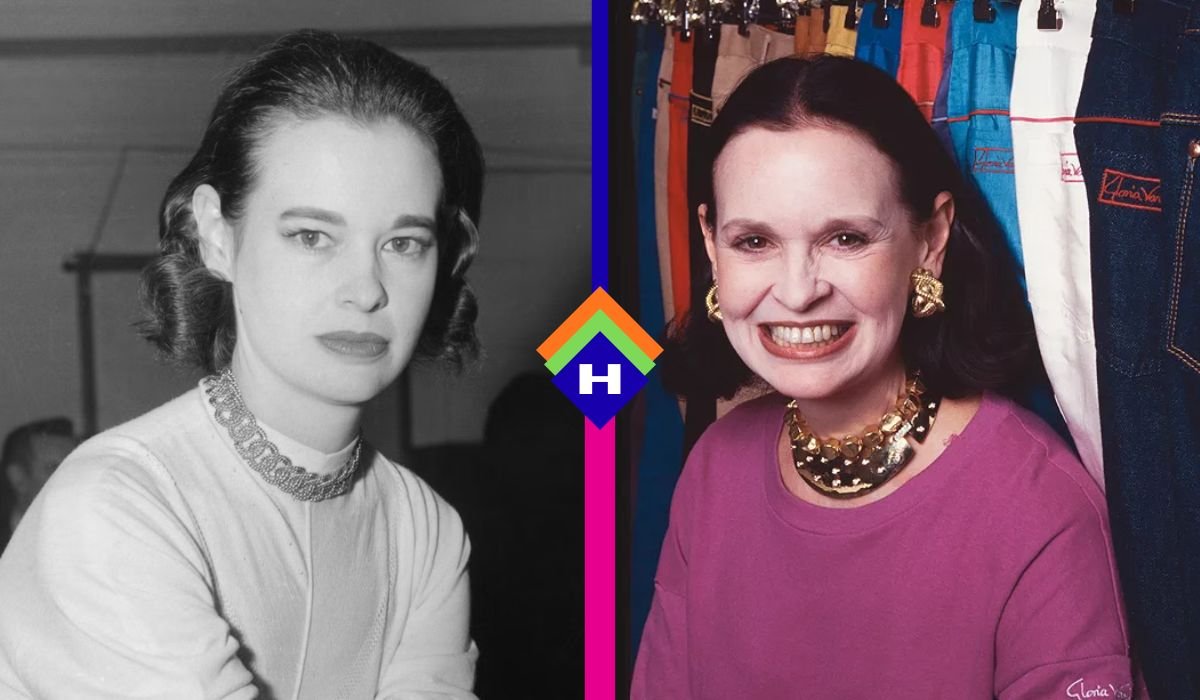
Long before Gloria Vanderbilt Jeans became a familiar name in American closets, Gloria Vanderbilt herself was already a household name. Born into the prominent Vanderbilt family, she grew up under an extraordinary level of public attention. But her most lasting connection to American fashion didn’t come from her family fortune or her life as a socialite. It came from an everyday piece of clothing: jeans.
During the 1970s, Gloria Vanderbilt Jeans helped change the way women viewed denim. The brand was built around a simple but powerful idea: jeans could be designed to fit a woman’s body more closely and flatter her shape. The result was a line known for its fitted silhouette, tapered styling, distinctive branding, and famous swan symbol.
There was much more behind that success than a celebrity name on a clothing label. Vanderbilt had already worked in home design and tried to establish her own dress business on New York City’s Seventh Avenue. That venture struggled. Her career took another turn when she began designing blouses for businessman Mohan Murjani. A conversation about denim fabric eventually led to the idea of creating a better-fitting pair of women’s jeans.
That idea would become one of the most important chapters in Vanderbilt’s career. It also helped establish a new relationship between celebrity, designer branding, and everyday American clothing.
Quick Bio Information
| Bio Detail | Information |
|---|---|
| Full Name | Gloria Laura Vanderbilt |
| Born | February 20, 1924 |
| Birthplace | New York City |
| Died | June 17, 2019 |
| Age At Death | 95 |
| Family Background | Member Of The Vanderbilt Family |
| Main Professions | Artist, Writer, Actress, Designer, And Socialite |
| Best Known Fashion Product | Gloria Vanderbilt Jeans |
| Major Denim Period | 1970s |
| Designer Jeans Launch | 1976 |
| Key Business Partner | Mohan Murjani |
| Key Merchandising Figure | Warren Hersch |
| Signature Brand Symbol | Swan |
| Signature Branding | Gloria Vanderbilt Signature |
| Main Denim Selling Point | Women-Focused Fit |
| Earlier Design Work | Home Products And Dresses |
| Famous Son | Anderson Cooper |
| Later Signature Style | Amanda Jean |
| Amanda Jean Introduced | 1993 |
| Long-Term Fashion Legacy | Early Designer And Celebrity-Branded Denim |
Who Was Gloria Vanderbilt?
Gloria Laura Vanderbilt was born in New York City on February 20, 1924. Her family name alone made her famous. She was a descendant of Cornelius Vanderbilt, the railroad and shipping magnate whose enormous fortune established the Vanderbilt family as one of the best-known dynasties in American history.
Vanderbilt’s childhood was surrounded by intense media attention. Following the death of her father, a highly publicized custody battle over her became a major news story. Yet as she grew older, she worked to establish an identity that extended well beyond her family’s wealth and reputation.
She became involved in several creative fields, including art, writing, acting, and design. She studied art and developed a serious interest in painting, while fashion eventually became another major part of her professional life.
That background matters when looking at the success of Gloria Vanderbilt Jeans. Vanderbilt wasn’t simply a famous heiress whose name happened to appear on a pair of pants. She had spent years exploring design and learning how creative ideas could be turned into consumer products.
Gloria Vanderbilt’s Early Design Career
Vanderbilt’s fashion story began well before denim. In the late 1960s, she became involved in the design of household products and licensed collections that included items such as linens, china, and glassware.
She recalled spending about three years working with home-design products and traveling to stores to introduce her collections. The experience gave her a firsthand understanding of retail and consumer tastes. She wasn’t only creating designs; she was also learning how those designs were presented and sold.
Her next step took her to New York City’s Seventh Avenue, a major center of the American garment industry. Vanderbilt established her own dress-design business there and ran it for about two years.
Unfortunately, the business struggled. Vanderbilt later recalled that the company was going bust, forcing her to rethink her direction.
That setback might have ended the fashion ambitions of someone else. For Vanderbilt, however, it became another stage in a much longer journey.
The Seventh Avenue Business That Nearly Failed
The difficulties surrounding Vanderbilt’s dress business are an important part of the story because they show that her eventual fashion success wasn’t guaranteed.
Rather than leaving the industry, she moved into another opportunity. Vanderbilt met Mohan Murjani, an Indian businessman whose company was involved in the garment business on Seventh Avenue. She began designing blouses for Murjani, bringing her creative experience into an established business environment.
The move proved significant. Working with Murjani gave Vanderbilt access to a company with experience in manufacturing, merchandising, and distribution. It also brought her into contact with people who could help turn a design idea into a commercial product.
Among them was Warren Hersch, a merchandising executive whom Vanderbilt later described as a merchandising genius. His role would become particularly important when denim entered the conversation.
How Mohan Murjani Entered The Story
Murjani’s business became the setting for Vanderbilt’s next major career move.
While Vanderbilt was working on blouse designs, Hersch told her that the company had a substantial amount of denim fabric stored in Hong Kong. For most people, that might simply have sounded like excess inventory. Vanderbilt saw something else: an opportunity.
Her response was straightforward. Why not make jeans?
But Vanderbilt didn’t want to make just another pair of jeans. She wanted to create a pair with what she described as a really great fit.
That idea became the foundation of the designer-jeans venture. It was a deceptively simple concept, but the timing couldn’t have been better. Denim was becoming an increasingly important part of American fashion, and consumers were looking for styles that went beyond traditional workwear.
Vanderbilt recognized that women’s jeans could be designed around the shape of the wearer. That became the central idea behind the brand.
The Idea Behind Gloria Vanderbilt Jeans
The appeal of Gloria Vanderbilt Jeans centered on fit. The goal was to create jeans that followed a woman’s shape and offered a more flattering silhouette than many of the looser styles available at the time.
The original jeans were associated with a close-fitting shape and tapered appearance. They were designed to emphasize the waist and curves rather than treating denim as a generic, one-shape-fits-all garment.
The brand identifies 1976 as the launch year for its designer-jeans line. Some historical accounts describe the jeans as going on sale in 1977, so the timeline is best understood as a launch beginning in 1976 followed by the retail rollout around that period.
Whatever date is used for the first store sales, the larger historical point remains the same. Vanderbilt entered the market at a time when denim was moving rapidly from practical clothing into mainstream fashion.
Her approach gave women a product that combined the familiar appeal of jeans with the fit and identity of designer clothing.
What Made The Jeans Stand Out?
The emphasis on fit was only part of the equation. Gloria Vanderbilt Jeans also had a visual identity that made them easy to recognize.
The jeans carried Vanderbilt’s signature, while the swan became one of the brand’s most memorable symbols. According to the Murjani Group’s account of the original design, Vanderbilt’s signature appeared on the back pocket and the swan was featured on the front coin pocket.
Those details mattered because branding was becoming increasingly important in fashion. A consumer didn’t have to turn a garment inside out to know which label it was. The signature and swan were visible parts of the design.
The result was a product with several layers of appeal. The fit gave shoppers a practical reason to choose the jeans. The branding gave them a recognizable identity. And Vanderbilt’s celebrity status added another dimension to the product.
The jeans weren’t simply anonymous denim anymore. They had a story, a designer, and a name people already knew.
Why The Swan Became So Important
The embroidered swan became closely associated with Gloria Vanderbilt Jeans, helping the brand stand out in an increasingly competitive denim market.
Its value was partly visual. When someone wore the jeans, the branding could be seen by other people. That turned the garment itself into a form of advertising.
The swan also worked alongside Vanderbilt’s name. The combination of a distinctive symbol and a recognizable signature created an identity that consumers could remember easily.
This was particularly effective because Vanderbilt was personally connected to the brand. She wasn’t an unknown designer operating behind a corporate label. Her name, image, and reputation were part of the product.
That approach helped establish Vanderbilt as an early example of celebrity-driven fashion branding, at a time when the idea was still developing into the powerful commercial strategy it is today.
How Gloria Vanderbilt Promoted Her Jeans
Marketing was a major part of the brand’s rise.
Vanderbilt promoted her jeans on television, putting herself directly in front of consumers. The company also advertised on buses and in other highly visible public spaces.
Television was particularly valuable because it allowed consumers to connect the famous Vanderbilt face with the clothing carrying her name. The jeans weren’t being sold as an abstract fashion label. Vanderbilt herself became part of the sales message.
At the same time, the use of public advertising helped take the brand beyond traditional fashion audiences. The jeans were available through department stores, bringing the Vanderbilt name into mainstream shopping.
The strategy combined celebrity recognition with mass-market distribution. Consumers didn’t need to be part of high society or wealthy enough to buy couture. They could simply walk into a department store and purchase a pair of jeans bearing the name of one of America’s most famous families.
How Gloria Vanderbilt Jeans Became A 1970s Fashion Phenomenon
The rise of Gloria Vanderbilt Jeans coincided with a major change in the cultural meaning of denim.
Jeans had begun as practical clothing associated with labor and work. By the 1960s and 1970s, however, denim had become a symbol of youth culture, individuality, and American popular fashion.
Vanderbilt entered this changing market with a product designed specifically around women’s fit. That distinction helped give the brand a clear place in the growing designer-jeans category.
The jeans became a major commercial success, and their popularity extended well beyond Vanderbilt’s existing social circle. The brand’s combination of recognizable design, celebrity appeal, accessible retail, and strong marketing helped make it one of the most visible names in women’s denim.
The success also created opportunities for the Vanderbilt name to expand into other consumer categories, including clothing, accessories, home products, and fragrances.
Denim was the breakthrough. It became the foundation for something much larger.
From Socialite To Fashion Entrepreneur
Perhaps the biggest change brought by the jeans was the transformation of Vanderbilt’s public identity.
She had been famous for decades, but much of that fame was connected to her family, her childhood, and her life in the public eye. The jeans gave consumers another reason to know her.
Her name was now attached to something they could actually buy and wear.
That distinction is important. The success of Gloria Vanderbilt Jeans wasn’t simply the result of putting an aristocratic surname on clothing. The product had a clear selling point, while Murjani’s organization brought manufacturing and merchandising experience to the business.
Vanderbilt, meanwhile, supplied the creative identity and celebrity recognition that made the brand distinctive.
Together, those elements created an early and highly successful example of the personal-brand model that has become commonplace in modern fashion.
Anderson Cooper’s Memories Of The Jeans
One of the most memorable details about Vanderbilt’s denim success comes from her son, Anderson Cooper.
Cooper recalled that he and his brother had a game in which they counted how many women they saw wearing jeans with their mother’s name on them.
It’s a small family story, but it captures the scale of the brand’s popularity better than statistics alone might. Vanderbilt’s name wasn’t merely appearing in advertisements or fashion magazines. It was turning up on women walking through everyday public spaces.
Cooper said he had always known that his mother was well-known. But the jeans took her visibility to another level.
For him, the success was something he could literally see around him. That personal memory offers a glimpse into how unusual it must have been for a family member to watch a parent’s name become part of everyday fashion.
How The Jeans Changed Vanderbilt’s Legacy
The commercial success of the jeans helped establish Vanderbilt as a genuine fashion entrepreneur.
Her story also reflected a larger change in American clothing. Designer names were no longer limited to expensive, exclusive fashion. A designer’s identity could now be attached to something as familiar and accessible as a pair of jeans.
That shift had lasting consequences for the fashion industry.
Vanderbilt’s success showed that a personal name could have commercial power when it was combined with a product consumers actually wanted. In her case, the product had a straightforward benefit: a more flattering approach to women’s denim.
Her celebrity brought attention, but fit and design helped keep consumers interested.
That distinction is one reason her denim story remains important. It wasn’t celebrity alone that made the brand successful. It was the combination of celebrity, product design, merchandising, and marketing.
The Gloria Vanderbilt Brand After Denim
Although jeans became the defining commercial chapter of Vanderbilt’s fashion career, the brand eventually grew beyond denim.
The Vanderbilt name appeared on clothing and accessories as well as home products and fragrances. The expansion showed how successfully the original personal brand had transferred into other consumer categories.
The denim business itself also had a remarkably long life.
The brand’s history dates the introduction of the Amanda Jean to 1993. The style later became the company’s best-selling jean in America in 2006. The continued presence of Amanda styles demonstrates that Vanderbilt’s original focus on fit wasn’t limited to the fashions of the 1970s.
That longevity adds another layer to her legacy. The brand wasn’t remembered solely because of a nostalgic moment in fashion history. Its core idea—making jeans with a flattering women’s fit—continued to shape the product decades later.
Gloria Vanderbilt’s Fashion Legacy In 2026
Gloria Vanderbilt died on June 17, 2019, at the age of 95. Her influence on American fashion, however, has continued well beyond her lifetime.
In 2026, celebrity fashion labels and personality-driven brands are everywhere. Designers, entertainers, athletes, and influencers routinely attach their names to clothing, accessories, beauty products, and other consumer goods.
Vanderbilt’s jeans belong to an earlier period in that evolution. Her success demonstrated how powerful a personal brand could become when it was connected to an accessible product with a clear purpose.
The formula was remarkably effective. The jeans had a recognizable silhouette. The signature and swan created instant visual branding. Vanderbilt’s public profile generated attention, while television and public advertising brought the product to a mass audience.
Most importantly, the jeans gave consumers a reason to care beyond the famous name. They were designed around fit.
That’s why the story of Gloria Vanderbilt Jeans still matters. It wasn’t simply about a celebrity selling clothing. It was about changing the way a familiar garment could be designed, marketed, and understood.
Final Thoughts
The story of Gloria Vanderbilt Jeans is ultimately a story about reinvention.
Gloria Vanderbilt was born into extraordinary wealth and became famous at an early age, but one of her most enduring achievements came from creating a product that could be found in the wardrobes of ordinary Americans.
Her route to denim was anything but predictable. She worked with home-design products, tried to establish a dress business that struggled, moved into blouse design, and eventually found an opportunity through Mohan Murjani’s company.
Warren Hersch’s observation about the stored denim provided the spark. Vanderbilt’s response supplied the idea: make a pair of jeans with a great fit.
Everything that followed built on that concept.
The fit gave the jeans a clear purpose. Vanderbilt’s name supplied instant recognition. The swan and signature created a memorable visual identity. Television and public advertising expanded the audience. Department-store distribution made the product accessible to mainstream consumers.
Together, those elements turned Gloria Vanderbilt from a famous name into a powerful fashion brand.
Her denim legacy also illustrates a broader change in American fashion. Jeans were no longer simply practical trousers. They had become a way to express identity, style, and even designer status.
Decades later, that idea is still familiar. What makes Vanderbilt’s story remarkable is that she was helping establish the formula at a time when designer-name denim was still a relatively new concept.
Her greatest fashion achievement, then, wasn’t simply putting her name on jeans. It was understanding that an everyday garment could become something much more personal—and building a brand around that insight.
FAQs About Gloria Vanderbilt Jeans
When Did Gloria Vanderbilt Jeans Launch?
The Gloria Vanderbilt brand identifies 1976 as the launch year for its designer-jeans line. Some historical accounts describe the jeans as going on sale in 1977, so the most accurate way to describe the timeline is that the designer-jeans venture began in 1976 and reached consumers around that period.
What Made Gloria Vanderbilt Jeans Famous?
The jeans became famous for their close, flattering fit, recognizable branding, and extensive marketing. Vanderbilt’s signature and the swan helped distinguish the product, while television and public advertising gave the brand broad visibility.
Who Was Mohan Murjani?
Mohan Murjani was the businessman whose company partnered with Vanderbilt to develop and market the designer-jeans line. His organization provided important expertise in garment manufacturing, merchandising, and distribution.
What Was The Swan On Gloria Vanderbilt Jeans?
The swan was one of the brand’s signature visual elements. It became closely associated with Gloria Vanderbilt’s jeans and helped consumers identify the product. The original design also incorporated Vanderbilt’s signature as another prominent branding feature.
Was Gloria Vanderbilt A Designer Before Making Jeans?
Yes. Vanderbilt had already worked in home-product design and operated a dress-design business before moving into blouse design with Murjani. Her creative career also included art, writing, and acting, giving her a broad background in the arts and design.
What Was The Amanda Jean?
The Amanda Jean became one of the most important later styles associated with the Gloria Vanderbilt brand. The brand’s history dates its introduction to 1993 and says it became the company’s best-selling style in America in 2006.
How Did Anderson Cooper Describe His Mother’s Jeans?
Anderson Cooper recalled that he and his brother would count women wearing jeans with their mother’s name on them. He explained that he already understood his mother was famous, but the success of the jeans made her visibility seem much greater.
Why Are Gloria Vanderbilt Jeans Important In Fashion History?
Gloria Vanderbilt Jeans helped popularize designer-name denim designed with women’s fit in mind. The brand also demonstrated how celebrity, personal branding, product design, merchandising, and mass-market advertising could work together to turn an everyday garment into a major fashion business.
Learn more and explore exciting content on: Augusta Wilhelmine Gein: The Life Story of Ed Gein’s Mother














Leave a Reply