
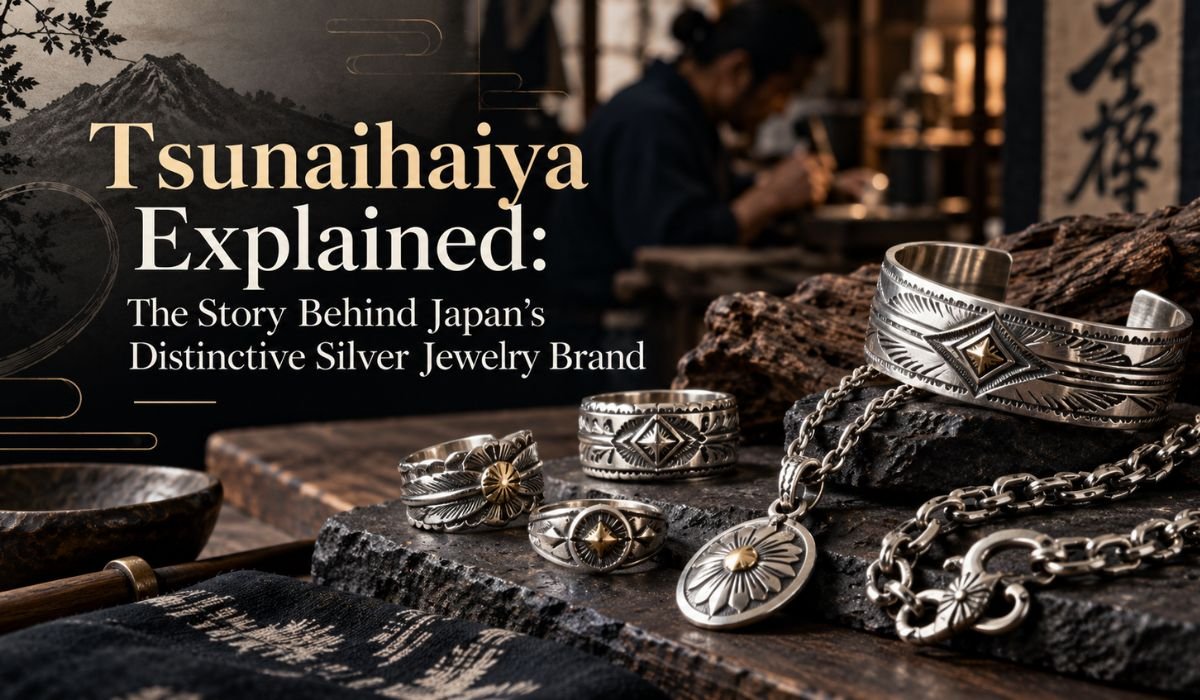
Some jewelry exists simply to complete an outfit. Other pieces carry a story in their materials, surfaces, and shapes. Tsunaihaiya falls into the latter category. The Japanese jewelry brand has developed a distinctive identity around silverwork, sculptural forms, natural imagery, and craftsmanship that rewards a closer look.
Established in 2012, Tsunaihaiya is particularly interesting because its creative story stretches beyond Japan. The brand’s background includes metalworking experience developed in Santa Fe, New Mexico, along with artistic relationships connected to the American Southwest. Those experiences meet Japanese design influences in jewelry that can feel rugged, refined, organic, and contemporary at the same time.
That character is visible across the catalog. A Snake Ring curls around the finger rather than behaving like an ordinary band. Textured bangles make dents, grooves, and uneven surfaces part of the design. Colorful stone bracelets offer a lighter alternative to substantial silver pieces.
For anyone discovering the name for the first time, however, there is more to understand than appearance alone. The history, craftsmanship, materials, cultural influences, sizing, authenticity, and care of Tsunaihaiya jewelry all deserve attention.
What Is Tsunaihaiya?
Tsunaihaiya, also styled as Tsunai Haiya, is a Japanese designer jewelry brand associated primarily with artisan silver jewelry. Its catalog has included rings, bangles, bracelets, necklaces, and other accessories, with sterling silver appearing prominently across many designs.
What immediately separates Tsunaihaiya from more conventional jewelry is its treatment of metal. Smooth perfection isn’t always the goal. Instead, the brand often allows hammered surfaces, stamps, grooves, darkened areas, irregular textures, and visible finishing details to give a piece its personality.
That approach creates jewelry with a tactile quality. A design may appear relatively simple from across the room, yet reveal numerous small details when viewed up close. Light catches polished edges differently from rough surfaces, while darker recesses can make stamped patterns more noticeable.
This places much of Tsunaihaiya’s work somewhere between practical jewelry and miniature wearable sculpture. Some designs are restrained enough for daily use. Others are deliberately bold and work better as statement pieces.
Quick Bio Information About Tsunaihaiya
| Brand Information | Details |
|---|---|
| Brand Name | Tsunaihaiya |
| Alternative Styling | Tsunai Haiya |
| Japanese Styling | ツナイハイヤ |
| Country | Japan |
| Industry | Designer Jewelry And Accessories |
| Established | 2012 |
| Key Names | Yusuke Kuwano And Craig Dan Goseyun |
| Principal Designer Associated With The Brand | Yusuke Kuwano |
| Important Creative Connection | Santa Fe, New Mexico |
| Main Specialty | Artisan Silver Jewelry |
| Major Product Types | Rings, Bangles, Bracelets And Necklaces |
| Core Material | Sterling Silver In Many Designs |
| Other Materials | Natural Stones, Brass And Plated Metals |
| Recognizable Motifs | Snake, Deer And Feather Forms |
| Notable Style | Texturerized Silver Jewelry |
| Color-Based Designs | Colorfield Beads |
| Surface Character | Hammered, Stamped And Textured Finishes |
| General Aesthetic | Sculptural And Organic |
| Cultural Influence | Japanese Design With Southwestern Metalworking Connections |
| Best Suited To | Buyers Seeking Distinctive Artisan Jewelry |
These details provide a useful snapshot of the brand, but individual pieces shouldn’t be judged solely by general descriptions. Materials, finishes, availability, and construction can differ between collections, so specifications for a particular product remain important.
The Story Behind Tsunaihaiya
To understand Tsunaihaiya, it helps to begin with Yusuke Kuwano, the Japanese artist and jewelry designer closely associated with the brand.
Retailer biographies describe Kuwano moving to Santa Fe, New Mexico, in 2009. It was a significant setting for an aspiring metalsmith. Santa Fe has a substantial arts community and deep historical connections with jewelry and silversmithing traditions developed by Indigenous peoples of the American Southwest.
Kuwano studied metalwork at the Institute of American Indian Arts. Biographical material published by retailers also credits him with recognition in student jewelry competitions and describes his experience studying under Navajo jeweler Michael Roanhorse.
After completing his Bachelor of Fine Arts in 2012, Kuwano established Tsunaihaiya with San Carlos Apache sculptor Craig Dan Goseyun.
That history gives important context to the jewelry that followed. The brand’s Southwestern influence wasn’t simply selected from a mood board or adopted as a passing fashion theme. Kuwano’s design development was shaped by education, personal relationships, and practical experience in New Mexico.
What Does Tsunaihaiya Mean?
The brand’s unusual name naturally invites questions. Tsunaihaiya isn’t a familiar Japanese word to most readers, and descriptions of its meaning point back to the cross-cultural story behind the label.
Japanese retailer materials commonly describe “Tsunai Haiya” as an Apache expression connected with Japan and the idea of the “land of the rising sun.” In the context of the brand, that explanation creates a symbolic bridge between its Japanese identity and the Southwestern relationships involved in its development.
There is, however, an important qualification.
An authoritative independent Apache-language reference confirming the exact translation is difficult to establish. It would therefore be misleading to present the retailer explanation as an unquestionable dictionary definition.
The more careful interpretation is that this is the meaning attributed to the name in brand-related and retail descriptions. Making that distinction is especially important when discussing a living Indigenous language and its cultural context.
Japanese And Native American Influences
Descriptions of Tsunaihaiya often refer to a meeting of Japanese design and Native American metalworking. Broadly, that’s useful. Look more closely, though, and the story requires greater precision.
There is no single “Native American jewelry style.” Navajo, Apache, Hopi, Zuni, and many other Indigenous peoples have their own histories, artistic practices, techniques, and cultural traditions. Treating them as one interchangeable category would erase important differences.
Tsunaihaiya’s connection is more specific. It comes through Kuwano’s metalworking education in Santa Fe, his artistic relationships, and the brand’s early collaboration with Craig Dan Goseyun.
Japanese influences appear in another way. Natural imagery, carefully controlled forms, and references associated with Japanese storytelling and visual culture can be found in different pieces.
Seen in that context, Tsunaihaiya is best understood as a contemporary Japanese jewelry brand shaped by particular cross-cultural experiences. That description is both more accurate and more useful than treating its work as a general representation of Indigenous jewelry.
What Makes Tsunaihaiya Silver Jewelry Different?
Spend a moment looking closely at Tsunaihaiya silver jewelry and one feature quickly becomes apparent: the surface matters.
Many mainstream jewelry designs aim for flawless polish and perfect uniformity. Tsunaihaiya often finds character elsewhere. Hammer marks, stamped patterns, grooves, oxidation, irregular textures, and contrasting polished areas can become central elements rather than imperfections to be hidden.
The effect changes as the jewelry moves. Bright edges catch the light, recessed areas appear darker, and textured surfaces create smaller reflections across the metal.
Shape is equally important.
A conventional ring begins with a circular band. A Tsunaihaiya Snake Ring, by contrast, can use the twisting animal form as part of the ring’s structure. Antler-inspired bangles translate branching organic lines into silver. Feather designs take a light natural object and reinterpret its shape in metal.
This interplay between texture and three-dimensional form is a major reason Tsunaihaiya jewelry remains recognizable without relying on oversized gemstones or excessive decoration.
Materials Used In Tsunaihaiya Jewelry
Sterling silver sits at the heart of many Tsunaihaiya designs, but that doesn’t mean every product is constructed in exactly the same way.
Traditional sterling silver contains 92.5 percent silver, with the remaining percentage made up of other metals that improve its practical strength. For a brand interested in stamping, polishing, oxidation, hammering, and surface texture, silver offers considerable creative flexibility.
Tsunaihaiya has also used additional materials in particular products. Retail descriptions identify natural stones, brass, plated surfaces, and contrasting metal details across selected designs.
The Colorfield Bead styles expand the palette further. Stones identified in retailer descriptions include turquoise, lapis, moonstone, onyx, and magnesite, giving these pieces a noticeably different character from the brand’s heavier silver jewelry.
These distinctions aren’t merely technical. Material affects weight, durability, maintenance, appearance, and potentially price. A plated ring will age differently from a solid sterling silver piece, just as natural stone requires different care from metal.
For buyers, checking the exact product specification is far safer than assuming everything carrying the Tsunaihaiya name is solid silver.
The Craftsmanship Behind The Jewelry
Much of Tsunaihaiya’s personality comes from what happens to the metal after its basic form has been created.
Hammering can leave shallow impressions across a surface, changing how it reflects light. Stamping introduces repeated patterns and marks. Cutting or carving can produce deeper lines, while twisting transforms the overall shape rather than simply decorating its exterior.
Certain Tsunaihaiya pieces also feature surfaces described in connection with reticulation. In metalsmithing, reticulation is used to create an intentionally wrinkled, uneven texture. Instead of looking perfectly smooth, the metal develops a landscape-like surface with peaks, depressions, and irregular patterns.
Finishing adds another layer. Oxidized or darkened recesses can sit next to highly polished edges, making stamped details easier to see.
This is why apparently simple silver jewelry can reveal surprising complexity at close range. The visual interest doesn’t necessarily come from adding more materials. Often, it comes from manipulating the silver already there.
Hand-finishing may also mean that individual examples show small differences. Those variations can add character, although buyers shouldn’t assume that every scratch, dent, or damaged area is automatically evidence of handmade craftsmanship.
Signature Tsunaihaiya Designs
Although Tsunaihaiya has explored different ideas, several designs help establish its visual identity.
The Snake Ring is among the most recognizable. Rather than placing a snake decoration on top of a conventional ring, the twisting body itself contributes to the shape. Stamped details can suggest scales, while some versions include contrasting accents around smaller features.
The Texturerized designs take a different route. Here, the silver surface becomes the attraction. Rough, hammered, irregular, and reticulation-like finishes give relatively straightforward forms greater depth.
Then there are Colorfield Beads, which introduce natural stones and more obvious color. These bracelets can feel lighter and more relaxed than substantial silver rings or bangles, making them particularly suitable for layering.
Deer-inspired pieces translate antler shapes into sculptural jewelry, while feather-related designs explore longer, more detailed organic forms. Product names such as Sunbow, Kaguya, Chuva, and James Crowe Feather have also appeared through specialist retailers.
As with many smaller designer labels, availability changes. A design found in an older catalog or retailer archive shouldn’t automatically be assumed to remain in current production.
Nature And Symbolism In Tsunaihaiya
Nature runs through much of Tsunaihaiya’s visual language. Snakes curve around fingers, antler-like forms branch outward, and feathers become elongated metal shapes.
These subjects naturally invite symbolic interpretation. That is also where writers and buyers need to be careful.
Snakes, deer, feathers, weather, and other natural elements can carry significant meanings in Japanese traditions as well as in different Indigenous cultures. Those meanings aren’t universal, however, and shouldn’t automatically be attached to every piece of jewelry featuring the same animal or shape.
Unless the designer has identified a specific symbolic intention, broader cultural interpretations are best treated as context rather than established explanations of a particular design.
Fortunately, the pieces don’t require elaborate symbolism to make visual sense. A snake naturally lends itself to twisting movement. Antlers produce elegant branching curves. Feathers offer fine linear patterns.
In Tsunaihaiya jewelry, nature works as both a possible source of meaning and a practical source of form.
How To Style Tsunaihaiya Jewelry
The stronger a piece of jewelry looks, the less competition it usually needs from the rest of an outfit. That principle suits Tsunaihaiya particularly well.
A substantial silver ring can become the main accessory alongside a white shirt, dark denim, knitwear, or an understated jacket. Textured bangles work in much the same way. Their surfaces add visual interest without requiring bright colors or elaborate clothing.
Colorfield bracelets are more flexible. Natural stones introduce blues, whites, dark tones, and turquoise shades that can be combined with casual clothing or layered with other bracelets.
Scale matters when several pieces are worn together. One sculptural ring alongside smaller bracelets can create a more considered look than stacking multiple oversized designs without a clear focal point.
Some retailers describe Tsunaihaiya jewelry as unisex. In practice, personal taste, dimensions, wrist size, ring fit, and proportion are more useful considerations than gender labels.
Choosing The Right Tsunaihaiya Piece
A striking product photograph can attract attention, but choosing jewelry for real-world wear requires a few practical checks.
Size comes first. Wide rings often feel tighter than narrow bands carrying the same nominal measurement because more metal makes contact with the finger. Anyone ordering internationally should also confirm which sizing system the retailer uses.
Bangles require similar care. Internal dimensions, wrist circumference, opening width, and overall thickness can all affect comfort.
Weight is easy to overlook when shopping online. A substantial silver design may look impressive but feel noticeably different after several hours of wear.
Material should be checked just as carefully. If solid sterling silver is important to you, make sure the description explicitly says so. Don’t rely on the jewelry’s color or overall appearance.
Finally, think about purpose. An understated ring may make sense for everyday wear, while a large sculptural design can work better when you specifically want the jewelry to become the centerpiece.
How To Check Authenticity Before Buying
Authenticating designer jewelry isn’t as simple as identifying one stamp or comparing a single photograph.
With Tsunaihaiya, the safest approach is to consider several pieces of evidence together.
A credible seller should provide a clear product name, materials, dimensions, condition information, and detailed photographs. Images from several angles are especially useful when buying textured or sculptural jewelry because they reveal details that a front-facing catalog photograph can hide.
For pre-owned pieces, documentation can help. Original packaging, receipts, purchase records, or other provenance may increase confidence, though none of these should be treated as absolute proof on their own.
Warning signs include inconsistent descriptions, unclear materials, heavily edited or copied photographs, and prices that are dramatically below comparable products without a reasonable explanation.
Return terms deserve attention too. A transparent seller with clear product information and reasonable buyer protection generally offers greater reassurance than an anonymous listing with little documentation.
Where To Buy Tsunaihaiya And Understanding Price
Tsunaihaiya has been carried by Japanese fashion boutiques and specialist retailers focusing on designer or artisan jewelry. Older and discontinued pieces can also appear on resale platforms.
Stock isn’t necessarily consistent. Smaller designer labels often produce or distribute jewelry differently from mass-market brands, so a piece available today may become difficult to locate later.
Price varies for the same reason. The amount of silver, complexity of construction, stones, finishing, collection, condition, and retailer can all influence cost.
Retail listings are useful for understanding the general market, but a price found in one place shouldn’t be presented as the permanent official value of a particular Tsunaihaiya design.
International buyers have additional expenses to consider. Currency conversion, delivery fees, import duties, taxes, and potential return shipping can all change the true cost.
Before comparing two listings, it makes sense to calculate the complete purchase price rather than looking only at the amount shown beside the product.
How To Care For Tsunaihaiya Jewelry
Silver jewelry changes with wear, and that isn’t necessarily a bad thing. Still, sensible care can help Tsunaihaiya pieces age gracefully rather than deteriorate unnecessarily.
After wearing silver, wipe it gently with a soft, clean cloth. This removes moisture, oils, and residue before storage. Keeping pieces separately in dry pouches can also reduce scratches and exposure to humidity.
Sterling silver naturally tarnishes over time. Gentle polishing can restore brightness, but Tsunaihaiya’s textured and intentionally darkened surfaces need special attention. Aggressive polishing can remove oxidation that was deliberately used to highlight grooves and patterns.
Plated pieces are even less suited to abrasive cleaning because repeated polishing may gradually wear through the surface layer.
Natural stones create another set of considerations. Not every stone reacts well to chemicals, prolonged soaking, heat, or ultrasonic cleaning.
When the correct method isn’t clear, follow care instructions provided for the individual product or ask an experienced jeweler before using stronger cleaning methods.
What Buyers Should Know Before Ordering
Tsunaihaiya’s artistic character may be what attracts buyers, but practical details often determine whether a purchase turns out well.
Before ordering, confirm the material, dimensions, size, weight, condition, and return terms. International customers should also determine whether taxes and import charges are included at checkout or collected separately later.
For handmade or hand-finished jewelry, study the surface closely. Small variations may be expected, but substantial scratches, missing components, deformation, or worn plating can affect appearance and value.
This becomes particularly important with pre-owned or discontinued jewelry. Ask for recent photographs of the actual piece whenever possible instead of relying entirely on old catalog images.
A few minutes spent checking these details can be especially valuable when buying internationally, where returns may be expensive or complicated.
Why Tsunaihaiya Stands Out In 2026
Tsunaihaiya remains interesting because it doesn’t fit neatly into one familiar jewelry category.
It is Japanese in origin, yet part of its creative history leads to Santa Fe. Its pieces can appear rugged because of their textured surfaces, but their construction often reveals considerable control and precision. Natural forms provide inspiration, yet the results can look thoroughly contemporary.
Most importantly, the better designs don’t depend entirely on their backstory. A well-made Snake Ring can remain visually compelling even if the wearer knows nothing about the history behind it. A textured silver bangle can succeed because of its proportion, surface, and shape before anyone reads about its influences.
That gives Tsunaihaiya an interesting position within Japanese Silver Jewelry. It offers something different from both highly polished conventional luxury pieces and inexpensive mass-produced accessories.
For people drawn to tactile surfaces, sculptural shapes, and jewelry with an identifiable creative point of view, that’s a significant part of the appeal.
Final Thoughts
Tsunaihaiya is compelling because its story and its jewelry reinforce one another. The brand grew from Yusuke Kuwano’s Japanese background, his metalworking education and artistic relationships in Santa Fe, and the early involvement of Craig Dan Goseyun. Those experiences help explain why its work doesn’t look quite like conventional Japanese fashion jewelry.
Yet history alone isn’t what makes the brand interesting. The strongest argument for Tsunaihaiya can be found in the objects themselves.
Hammered and darkened surfaces give silver depth. Snake and antler forms introduce movement. Natural stones bring color to collections that might otherwise be dominated by metal. Small irregularities and finishing details encourage the wearer to look more closely.
At the same time, buyers shouldn’t allow an appealing story to replace careful research. Materials vary between products, sizing deserves attention, older designs may be difficult to find, and cultural interpretations should be treated carefully unless they are clearly documented.
Approached with that balance of curiosity and caution, Tsunaihaiya offers an intriguing window into contemporary Japanese Silver Jewelry—one shaped by craftsmanship, artistic exchange, natural forms, and a willingness to let the character of the metal become part of the design.
FAQs About Tsunaihaiya
Is Tsunaihaiya A Japanese Brand?
Yes. Tsunaihaiya is a Japanese jewelry brand established in 2012. Its creative history also has important connections with Santa Fe, New Mexico, where Yusuke Kuwano studied metalworking and developed relationships with artists associated with Southwestern jewelry traditions.
Who Founded Tsunaihaiya?
Tsunaihaiya is associated with Japanese artist Yusuke Kuwano and San Carlos Apache sculptor Craig Dan Goseyun. Retailer biographies describe the brand as beginning in 2012 after Kuwano’s period of study and artistic development in Santa Fe.
What Is Tsunaihaiya Known For?
The brand is particularly known for artisan silver jewelry with textured surfaces, sculptural construction, natural imagery, and unusual metal finishes. Snake Rings, Texturerized pieces, stone bead bracelets, and antler-inspired jewelry are among its recognizable designs.
Is All Tsunaihaiya Jewelry Sterling Silver?
No. Sterling silver is central to many Tsunaihaiya designs, but buyers shouldn’t assume that every product is made entirely from it. Retail descriptions of individual pieces also identify materials such as brass, plating, natural stones, and mixed components. Check the specifications before purchasing.
Is Tsunaihaiya Jewelry Handmade?
Retail descriptions frequently emphasize craftsmanship and individual finishing in Tsunaihaiya jewelry. However, production methods may vary between products and collections. For that reason, claims about how a specific item was made should be based on information provided for that particular piece.
What Does Tsunaihaiya Mean?
Retail descriptions associate “Tsunai Haiya” with an Apache expression connected with Japan or the rising sun. Because an authoritative independent linguistic reference confirming the precise translation is difficult to establish, the safest description is that this is the meaning attributed to the brand name in brand-related and retail material.
Is Tsunaihaiya Jewelry Worth Buying?
For someone who values textured silver, sculptural forms, distinctive Japanese jewelry, and artisan craftsmanship, Tsunaihaiya can be worth considering. Whether an individual piece represents good value depends on its materials, condition, price, authenticity, comfort, and how closely the design matches the buyer’s personal style.
How Can I Tell If Tsunaihaiya Jewelry Is Authentic?
Don’t rely on a single feature. Consider the seller’s reputation, product name, material description, detailed photographs, provenance, packaging when available, condition, and return policy together. If anything about a listing appears inconsistent, ask for additional information before buying.
Learn more and explore exciting content on: What Is kz43x9nnjm65? A Complete Guide to This Mysterious Code





Leave a Reply