
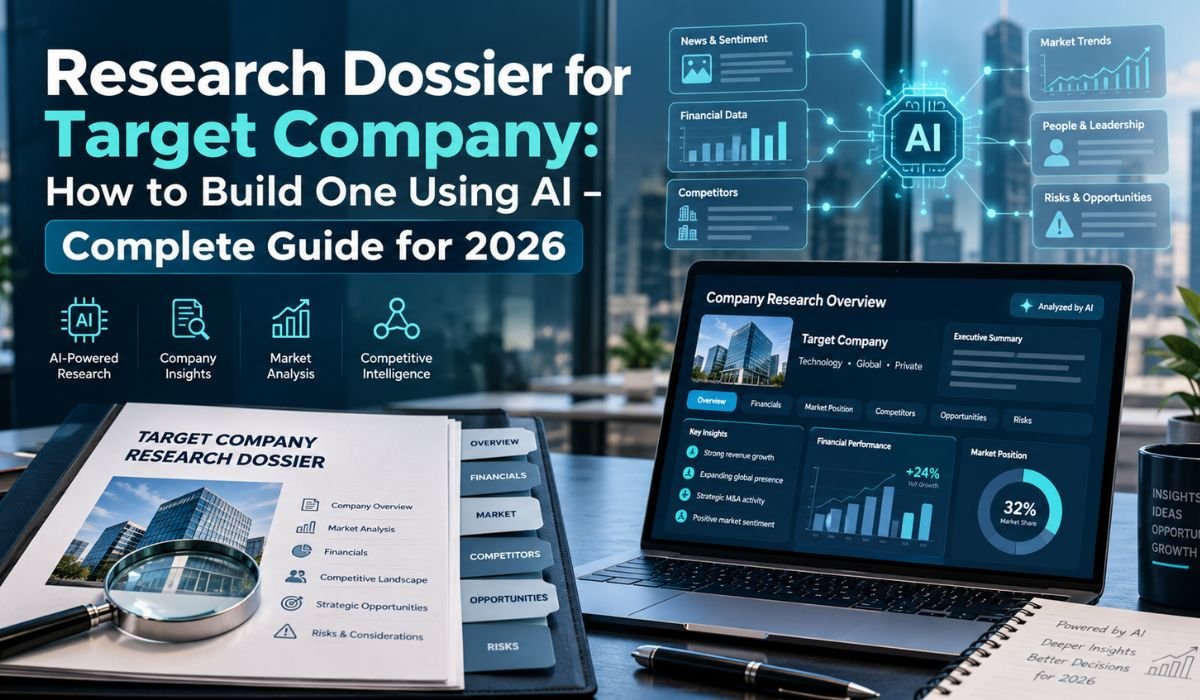
Building a Research Dossier for Target Company is about much more than gathering a company’s name, financial figures, leadership details, and latest news. Done properly, the dossier should answer a more useful question: what does all this information mean for the decision you’re trying to make?
That decision could involve investing in a business, approaching it as a sales prospect, approving it as a vendor, considering a partnership, or deciding whether further Due Diligence is worthwhile. In each case, the research needs to go beyond a basic Company Profile.
Artificial Intelligence has changed how quickly this work can be done. In 2026, AI Research Tools can help researchers work through lengthy reports, compare competitors, organize Financial Information, identify patterns, and surface potential risks. What they can’t do is guarantee that every conclusion is correct.
A convincing AI-generated report may still contain an old figure, an unsupported assumption, or a citation that doesn’t quite prove the claim beside it. That’s why the strongest approach combines AI’s speed with credible Primary Sources, careful verification, and Human Judgment.
This guide explains how to bring those pieces together and create a dossier that’s useful, current, and easier to trust.
What Is A Research Dossier For Target Company?
A Research Dossier for Target Company is a structured report that brings together verified facts, analysis, potential risks, and unanswered questions about a particular business.
The scope is usually broad. A detailed dossier can cover the company’s history, Business Model, Leadership, Ownership, Financial Performance, Products, Technology, Competitors, Growth Signals, and Recent Developments. But simply collecting these details isn’t enough. Good research also explains why they matter.
That’s one of the main differences between a Research Dossier and a Company Profile. A profile tells readers what a business is. A dossier helps them understand the business well enough to make a decision.
Consider a company that has recently appointed a new senior Sales Executive. Recording the appointment gives you a fact. Looking at whether the company is also hiring more Sales Staff, entering new regions, launching products, or changing its commercial strategy gives the fact context.
The purpose of the research should therefore shape the dossier from the beginning.
Quick Bio Information
| Research Detail | What It Covers |
|---|---|
| Primary Topic | Research Dossier for Target Company |
| Main Purpose | Evidence-Based Company Research |
| Research Approach | AI-Assisted and Human-Verified |
| Company Identity | Legal Name and Corporate Status |
| Company Background | History, Location, and Operations |
| Business Model | Customers and Revenue Sources |
| Financial Research | Revenue, Profitability, Cash Flow, and Funding |
| Leadership Research | Founders, Executives, and Board |
| Ownership Research | Parent Companies, Investors, and Shareholders |
| Market Research | Industry and Competitive Position |
| Competitor Research | Direct and Indirect Competitors |
| Product Research | Products, Services, and Technology |
| Growth Research | Hiring, Expansion, and Partnerships |
| Risk Research | Financial, Legal, Operational, and Reputation Risks |
| Source Standard | Primary Sources Preferred |
| AI Role | Discovery, Organization, Comparison, and Drafting |
| Human Role | Verification, Context, and Judgment |
| Evidence Status | Verified, Estimated, or Unverified |
| Final Output | Decision-Focused Company Research Report |
Why Target Company Research Matters
Business decisions are often made with incomplete information. Good Company Research won’t remove that uncertainty entirely, but it can reduce it considerably.
A company’s website, for instance, may present a confident story about growth, innovation, and customer success. That story can be useful, but it’s only one perspective. Financial Filings, Regulatory Records, Leadership Changes, customer concentration, litigation, hiring activity, and independent reporting may add important context.
A well-prepared dossier brings those different signals into one coherent picture while recognizing that not every source deserves equal weight.
The priorities also change with the reader. An investor may care most about Revenue Trends, Debt, Cash Flow, Ownership, Competitive Position, and downside risks. A Sales Team might focus instead on Leadership Changes, purchasing triggers, technology requirements, business priorities, and potential decision-makers. Procurement teams may place Financial Stability, Cybersecurity, compliance, and Vendor Risk near the top of the page.
Starting with the decision keeps the research focused. Without that discipline, it’s easy to collect pages of interesting information that never actually help anyone decide what to do.
How AI Is Changing Company Research In 2026
AI is particularly good at handling volume. Modern research systems can work through large amounts of public information, summarize long reports, compare businesses, organize evidence, and identify recurring themes far faster than traditional manual research.
Those capabilities make AI increasingly useful for Company Due Diligence, Sales Research, Market Analysis, and Competitive Intelligence.
There is, however, an important distinction between finding information and proving that information is correct.
An AI system may misunderstand part of a document, confuse two companies with similar names, overlook a newer disclosure, or express an uncertain conclusion with too much confidence. Even when a citation is provided, the source may not support the precise claim being made.
Financial research benchmarks published in 2026 have reinforced this concern. Research comparing Deep Research Agents with professional analyst work found that automated reports could gather substantial information but still showed weaknesses in areas including analytical depth, claim support, and professional Financial Reasoning.
For anyone building a Research Dossier, the lesson is straightforward. Let AI accelerate discovery and organization, but return to the underlying evidence before relying on an important conclusion.
Start With Company Identity And Business Model
Before digging into Financial Performance or market share, make sure you’ve identified the right business.
Confirm the Legal Company Name, jurisdiction, headquarters, official website, parent organization where relevant, important subsidiaries, and primary industry. This step may seem basic, but it prevents surprisingly common errors. Companies can have similar names, operate under trading brands, or sit within complicated corporate structures.
Official Business Registries can be particularly helpful for establishing legal identity.
Once the organization is clear, move to the Business Model. Ask a few practical questions. What does the company sell? Who pays for it? How does the company reach those customers? And how does money flow through the business?
Revenue may come from subscriptions, individual transactions, advertising, licensing, professional services, commissions, or a combination of models. The company may sell directly, operate online, rely on distributors, or work through strategic partners.
Understanding those mechanics gives later Financial Research meaning. A Revenue figure on its own says relatively little unless the reader understands the business generating it.
Research Financial Performance And Funding Carefully
Financial information often receives the most attention in a company dossier, and it’s also an area where poor sourcing can cause serious problems.
For publicly traded US companies, Regulatory Filings can provide information about Revenue, Profitability, Cash Flow, Debt, Segment Performance, material risks, and management’s view of the business. Annual reports offer broader context, while quarterly filings and current-event disclosures may reveal more recent developments.
Researching a Private Company is usually less straightforward.
Private businesses aren’t necessarily required to disclose the same level of financial detail publicly. Depending on the company and jurisdiction, researchers may need to rely on public accounts, Funding Announcements, investor disclosures, acquisition documents, company statements, and credible business reporting.
That makes labeling especially important.
If a third party estimates a company’s Revenue, don’t present the number as though it came from audited Financial Statements. The same principle applies to private-company valuations, employee estimates, Market Share, and other figures that aren’t directly confirmed.
A transparent estimate is far more useful than a false sense of precision.
Understand Leadership And Ownership
Numbers tell only part of a company’s story. The people running and controlling the organization can provide important clues about its priorities, experience, and direction.
A Research Dossier should therefore examine founders, Senior Executives, Directors, Parent Companies, significant shareholders, and publicly disclosed investors where relevant.
Previous roles can add useful context. So can recent appointments and departures. But Leadership Research requires restraint.
A new Chief Financial Officer doesn’t prove that an IPO is coming. A recently hired Sales Leader doesn’t automatically mean the company is preparing for rapid international growth. Those interpretations may be worth exploring, but they shouldn’t be presented as facts.
Look instead for supporting signals. A Leadership Change becomes more meaningful when it appears alongside Funding, new hiring, acquisitions, geographic expansion, or major Product Developments.
This is where thoughtful Company Research starts to separate itself from simple information collection.
Analyze Competitors And Market Position
Competitor Analysis works best when it begins with the problem customers are trying to solve.
Direct Competitors may sell similar products to the same customer group. Indirect Competitors may address the same need through a different product, service, or Business Model. In some markets, the strongest alternative isn’t another company at all; it may be an internal process or the customer’s decision to do nothing.
Once the competitive set is clear, compare the areas that matter. These may include Product Capabilities, target customers, publicly available pricing, geographic reach, distribution, partnerships, and positioning.
Be careful with sweeping descriptions such as “industry leader” or “fastest-growing company.” Unless strong evidence supports those claims, they’re better treated as marketing language than research findings.
Market Size figures deserve similar care. Different research firms can publish very different estimates because they define the market differently. Record what a figure includes, which geography it covers, the relevant period, and whether the number describes current spending or a future forecast.
Context makes Competitive Intelligence more valuable than a simple list of rivals.
Examine Products Technology And Innovation
Product Research should leave the reader with a clear understanding of what the company sells, who uses it, which problem it addresses, and how the offering differs from alternatives.
Official Product Pages are a natural starting point. Technical Documentation, release notes, public demonstrations, customer materials, and credible independent reviews can add more detail.
For technology businesses, Patent Records may provide another perspective. They can show technical areas in which a company or its inventors have sought protection and can sometimes reveal directions that aren’t obvious from marketing materials.
Still, patents need careful interpretation.
A Patent Application doesn’t mean a finished commercial product exists. Even a granted patent doesn’t establish that customers use the technology or that it generates meaningful Revenue. Likewise, announcing a new product doesn’t prove widespread adoption.
Good research keeps those distinctions visible rather than turning technical activity into evidence of commercial success.
Use Hiring And Growth Signals With Context
Job Postings can offer an unusually current view of where a business may be directing resources.
A cluster of Engineering vacancies might point toward Product Development. A wave of Sales Hiring across several countries could suggest expansion. New Security, Compliance, or Enterprise Support roles may indicate that the company is preparing to serve larger customers.
The key word is “may.”
Job Postings reflect intentions, and intentions can change. Roles can remain online after hiring priorities shift, while individual vacancies rarely reveal a company’s full strategy.
That’s why experienced researchers look for corroboration.
If a business begins hiring regional Sales Teams while announcing a local partnership, appointing a regional leader, and launching localized products, the combined evidence makes the expansion hypothesis much stronger.
Triangulating several independent signals is one of the simplest ways to improve AI-Assisted Company Research.
Track Recent News And Material Developments
A company can change significantly in a matter of months, so every dossier should make its research period clear.
Recent developments worth examining may include acquisitions, Funding Rounds, strategic partnerships, Product Launches, executive departures, restructurings, layoffs, lawsuits, Regulatory Actions, Cybersecurity Incidents, and geographic expansion.
Whenever possible, trace important news back to its original source.
A company announcement may establish that a partnership exists, while independent reporting may provide additional context about its significance. A Regulatory Filing may clarify details that were missing from the initial announcement.
Timing matters just as much as sourcing. Information that was accurate six months ago may have been overtaken by a later court decision, Financial Filing, acquisition, or Leadership Change.
Readers should never have to guess how fresh the evidence is.
Identify Risks Without Creating Alarm
Risk Analysis should make a dossier more balanced, not more dramatic.
Financial Risks might include falling Revenue, repeated losses, high Debt, limited liquidity, or dependence on a small number of customers. Operational Risks can include reliance on key suppliers, geographic concentration, infrastructure dependencies, or the loss of important employees.
Legal and Regulatory Risks may involve disclosed litigation, investigations, enforcement actions, or compliance problems. Depending on the business, Cybersecurity, Data Privacy, and Reputation Risk may also deserve attention.
The standard of evidence matters here more than almost anywhere else.
An isolated negative customer review isn’t proof of a company-wide problem. Nor should an unverified Social Media claim be elevated into a formal risk simply because it sounds serious. Such information can provide a lead, but stronger evidence is needed before drawing a firm conclusion.
Equally important, missing information shouldn’t automatically be interpreted negatively. Sometimes the correct research finding is simply: this couldn’t be confirmed.
Use A Clear Source Hierarchy
A trustworthy Research Dossier for Target Company makes it clear where its information came from and why certain sources deserve more weight than others.
Primary Sources generally provide the strongest foundation. Depending on the company and jurisdiction, these may include Regulatory Filings, official Business Registries, audited Financial Statements, Patent Records, court documents, regulator publications, and formal corporate disclosures.
Investor Relations materials and Company Websites are also useful. They can be authoritative sources for what a business has publicly announced, although promotional claims should still be recognized as the company’s own perspective.
Reputable journalism and established industry publications provide independent reporting and context. Reviews, forums, and Social Media are useful for discovering possible issues, customer concerns, or emerging themes, but important claims found there should normally be verified elsewhere.
Conflicting evidence deserves to be shown rather than hidden. When two credible sources disagree, record the difference and explain what can and can’t be established.
That transparency builds more Trustworthiness than pretending every question has a simple answer.
Build The Research Dossier Using AI
The most effective AI workflow begins before the first prompt is written.
Start by defining the decision the dossier must support. Identify the exact company, jurisdiction, audience, Research Period, and major questions. Then create a consistent structure covering Company Identity, Business Model, Financials, Leadership, Ownership, Products, Competitors, Growth Signals, Recent Developments, and Risks.
Collect high-quality Primary Sources early rather than allowing the AI to build its entire analysis from whatever pages appear first in a search.
From there, work through the dossier section by section. AI can summarize lengthy documents, extract relevant figures, compare evidence, organize information, and highlight gaps. Smaller research tasks are generally easier to inspect than one enormous request for a complete report.
Once the research is assembled, manually verify the claims that could change the decision. Revenue, Funding, Ownership, Executive Leadership, major customers, litigation, and material Regulatory Issues deserve particular attention.
Write the Executive Summary last. By then, the conclusion can follow the evidence instead of shaping it.
Improve AI Prompts With Evidence Rules
Good prompting isn’t about finding a magical phrase. It’s about giving the research system enough context and clear rules.
A useful Company Research Prompt identifies the exact business, country or jurisdiction, research objective, time period, preferred Source Types, and required sections. It should also explain what the AI should do when evidence is weak or contradictory.
Ask it to distinguish confirmed facts from estimates and interpretations. Require dates for time-sensitive sources. Tell it to flag conflicting evidence and say explicitly when reliable information can’t be found.
There’s another useful question that researchers often overlook: What evidence would weaken this conclusion?
That instruction encourages the system to look for contradictions rather than simply gathering material that supports its first interpretation. In practice, this can help reduce Confirmation Bias and expose areas requiring further investigation.
Verify Every Decision-Critical Claim
Verification is where a polished draft becomes dependable research.
Open the original source behind important Financial Figures, Funding Announcements, Executive Appointments, Ownership Claims, Legal Developments, customer concentration data, and Market Statistics. Then check whether the source really says what the dossier claims it says.
Pay attention to dates. Search for newer disclosures. If the original evidence is unavailable, say so.
One useful internal method is to classify findings as Verified, Partially Verified, Estimated, or Unverified. Not every label needs to dominate the final report, but decision-makers should be able to see where certainty ends and interpretation begins.
The dossier should also include a clear Research Date. Without one, even excellent work gradually becomes harder to trust because readers can’t tell how current the findings are.
Protect Privacy And Research Responsibly
AI can make Business Research easier, but it also introduces questions around privacy, confidentiality, and responsible information handling.
Research based entirely on legitimate public information is very different from uploading Private Deal Documents, customer lists, unreleased Financial Results, contracts, confidential strategy documents, or Personal Information to an AI system.
Before using sensitive material, organizations should understand the platform’s Data Retention, Security, Access, and Training policies and follow their own internal Data Governance requirements.
Researchers also need to respect applicable laws, intellectual property rights, website terms, and access restrictions when collecting information.
The fact that information can technically be accessed doesn’t automatically mean it should be collected, stored, or included in a dossier. Responsible Company Research stays focused on information that is relevant, appropriate, and obtained through legitimate means.
Keep The Company Dossier Current
Even the best Research Dossier has a shelf life.
Companies release new Financial Results, raise Funding, hire executives, enter markets, acquire competitors, launch products, lose customers, and face new Regulatory Developments. A report that was excellent when written can gradually become misleading if nobody updates it.
Every dossier should therefore include a Research Date, Version, and coverage period.
For public companies, Financial Results and material Regulatory Filings often provide natural review points. Private-company dossiers may need updating after major Funding, acquisitions, partnerships, Leadership Changes, or important Product Announcements.
An active Sales Opportunity, Vendor Review, or Investment Decision may require more frequent monitoring of Recent News.
Maintaining a simple change log also saves time. Instead of rebuilding the entire dossier, researchers can record what changed, when it changed, and why the development matters.
Final Thoughts
A strong Research Dossier for Target Company isn’t measured by the number of pages it contains. Its real value comes from helping readers distinguish important evidence from background noise.
They should be able to see what is known, where the information came from, how recently it was checked, which conclusions are well supported, and where uncertainty remains.
AI makes that process considerably faster in 2026. It can assist with discovery, document analysis, comparisons, organization, and early-stage interpretation. What it can’t do is remove the need for Expertise, context, Source Verification, and Human Judgment.
The most dependable approach starts with a clear business question, confirms the correct company, prioritizes Primary Sources, uses AI to accelerate the work, checks decision-critical claims, and openly acknowledges missing or uncertain information.
Handled that way, AI becomes more than a shortcut for producing reports. It becomes a capable research assistant, while people remain responsible for deciding what the evidence actually means.
FAQs About Research Dossier For Target Company
What Is A Research Dossier For Target Company?
A Research Dossier for Target Company is a structured report that combines verified business information with analysis. It can cover the company’s Business Model, Financial Performance, Leadership, Ownership, Products, competitors, Recent Developments, risks, and unanswered questions. Unlike a basic profile, the dossier is usually designed to support a specific business decision.
How Can AI Help Build A Company Research Dossier?
AI can speed up information discovery, summarize long documents, compare companies, organize evidence, and identify gaps that need further investigation. It can also help turn scattered research into a consistent report. Important findings should still be checked against reliable original sources before they’re used for a significant decision.
What Are The Best Sources For Target Company Research?
The best source depends on the claim being investigated. Regulatory Filings, official Business Registries, audited Financial Reports, regulator publications, Patent Records, and other Primary Sources are often the strongest options for factual verification. Company disclosures, established journalism, and respected industry publications can provide additional context.
How Do You Research A Private Company?
Private Company Research often requires combining several sources because detailed Financial Information may not be publicly available. Useful evidence can include official registry records, public accounts where available, Funding Announcements, investor disclosures, Company Publications, Patent Records, credible journalism, Job Postings, and industry information. Any Revenue, valuation, or other Financial Estimates should be labeled clearly.
How Do You Verify AI-Generated Company Research?
Start with the original evidence behind the claim. Confirm that the source actually supports the wording, check its publication date, and search for newer information. Pay particularly close attention to Financial Figures, Funding, Ownership, Leadership, Legal Matters, and Market Statistics because mistakes in these areas can materially change a conclusion.
What Is The Difference Between A Company Profile And A Research Dossier?
A Company Profile primarily describes the organization, including what it does and where it operates. A Research Dossier goes further by adding Financial Research, Competitive Intelligence, Source Verification, Risk Assessment, Information Gaps, analysis, and conclusions related to a specific decision.
How Often Should A Company Research Dossier Be Updated?
There’s no single schedule that works for every business. The right frequency depends on how quickly the company changes and why the research is being used. New Financial Results, Funding Rounds, acquisitions, Leadership Changes, Regulatory Developments, and major Product Launches are all good reasons to review the dossier.
Is AI Reliable Enough For Company Due Diligence?
AI can be highly useful during Company Due Diligence, particularly for discovery, summarization, organization, and comparison. It shouldn’t be the only basis for an important investment, legal, procurement, or strategic decision. Reliability improves when AI findings are supported by credible evidence, manually verified, clearly dated, and reviewed by people with relevant expertise.
Learn more and explore exciting content on: Escasinoes.com Explained: Casino News, Insights, and Essential Guides







Leave a Reply