
Publishing content is easy. Publishing the right content, for the right audience, with a clear reason behind it is much harder.
That distinction matters because businesses can spend months producing blog posts, landing pages, videos, newsletters, and social content without ever developing a coherent direction. The individual pieces may be useful, but if they don’t support broader priorities, the overall effort can become expensive, difficult to manage, and surprisingly ineffective.
This is where a Content Roadmap comes into the picture.
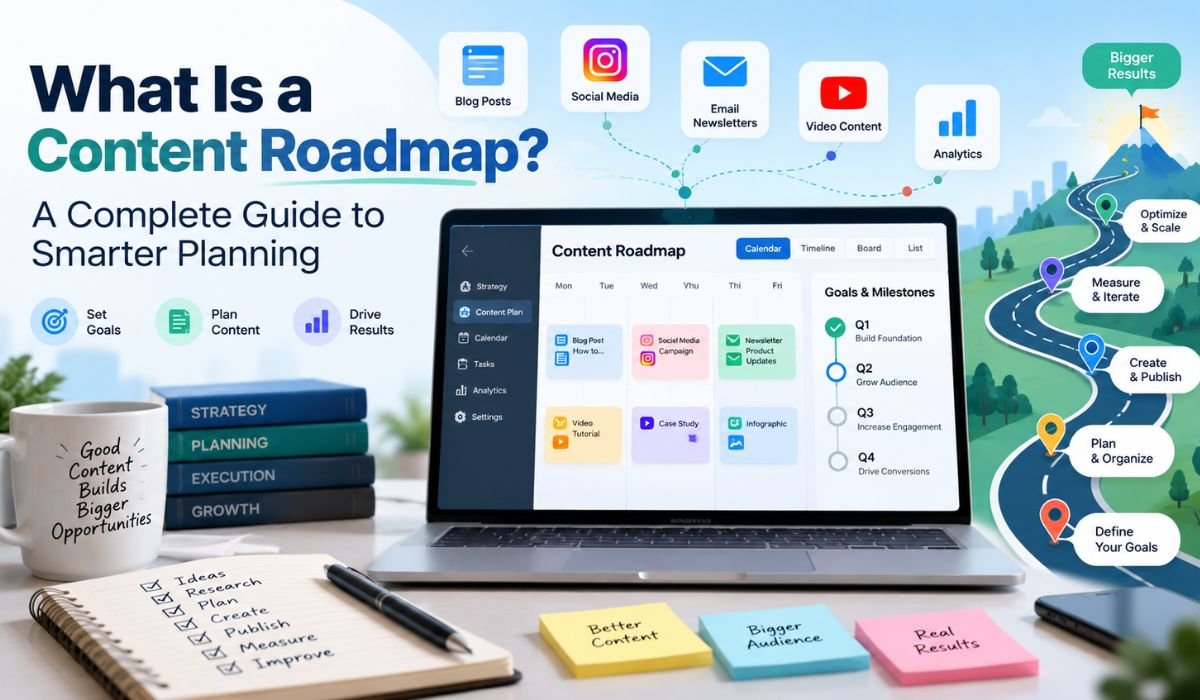
So, What Is a Content Roadmap? At its simplest, it’s a strategic plan that shows what content an organization intends to create, why that content matters, who it’s meant to help, and how it connects with wider marketing or business objectives.
A useful roadmap goes well beyond filling spaces on an editorial calendar. It helps teams decide which topics deserve investment, which existing pages need attention, what should be produced first, and how the results will eventually be measured.
That kind of discipline has become even more valuable in 2026. AI tools have made content production faster, audiences have an enormous amount of information competing for their attention, and search behavior continues to evolve. Simply producing more material isn’t enough. Businesses need content that’s accurate, useful, distinctive, and grounded in genuine audience needs.
What Is a Content Roadmap?
A Content Roadmap is a high-level planning document that connects future content activities with audience needs and organizational goals.
Depending on the business, it may cover priority topics, important themes, audience segments, campaigns, content formats, responsible team members, milestones, distribution plans, and performance goals. There’s no single format that every company must follow. A two-person startup won’t need the same system as an international marketing department.
What matters is the thinking behind the document.
Instead of repeatedly asking, “What should we publish next?” a good roadmap encourages more useful questions. Why does this topic deserve attention? Who needs this information? Which customer or business objective does it support? Have we already covered the subject? What should a reader understand or do after consuming the content?
Consider a software company preparing to launch an accounting platform. Publishing a collection of unrelated finance articles may generate activity, but it doesn’t necessarily create direction. A stronger roadmap could connect educational guides about bookkeeping challenges with product comparisons, buyer resources, onboarding material, and customer-support content.
Each piece has a different job, but all of them contribute to a larger purpose. That’s the central idea behind effective Content Roadmap Planning.
Why A Content Roadmap Matters
Content planning becomes difficult when every idea appears equally urgent.
Without clear priorities, teams can spend substantial amounts of time creating material that attracts the wrong audience, repeats information already available elsewhere on the website, or contributes little to the company’s actual objectives.
A Content Roadmap creates a useful filter.
It gives teams a framework for deciding what needs attention now, what can wait until later, and what may not deserve to be created at all. That alone can make content production more efficient and reduce the tendency to chase every topic a competitor happens to publish.
There are practical benefits inside the organization as well. Writers gain a clearer view of upcoming priorities. Designers can anticipate visual requirements. SEO specialists can research relevant search behavior before production starts. Sales, product, and customer-support teams can contribute real customer questions while there’s still time to shape the content.
Perhaps most importantly, a roadmap changes how success is viewed.
Publishing ten articles isn’t automatically better than publishing five. The more useful question is whether those articles helped the intended audience and contributed to the outcome they were created to support.
How A Content Roadmap Works
A practical Content Roadmap usually begins with an objective, not a collection of keywords.
Imagine an online retailer selling products that customers find difficult to compare. The company may decide that improving buyer confidence is an important goal. Its roadmap could begin with basic educational resources, move into comparison and selection guides, and later support purchase decisions with FAQs, demonstrations, and post-purchase information.
There’s a logical progression behind those choices.
Research reveals what customers need. Prioritization determines which needs should be addressed first. Production turns those priorities into useful resources. Distribution helps the right audience discover them. Measurement then provides evidence about what should be expanded, updated, combined, or reconsidered.
Seen this way, a roadmap isn’t really a finished document. It’s part of an ongoing cycle.
The most effective roadmaps therefore strike a balance between structure and flexibility. Teams need enough direction to stay focused, but they also need room to respond when customer questions change, products evolve, performance data reveals something unexpected, or a worthwhile opportunity emerges.
Content Roadmap Vs. Content Calendar
A Content Roadmap and a Content Calendar are closely connected, which is probably why they’re sometimes treated as interchangeable. They aren’t.
The roadmap operates at a strategic level. It helps answer questions about which themes deserve investment, which audiences the business wants to serve, and what outcomes the content should support.
The Content Calendar is much more concerned with execution. It records individual assignments, deadlines, publication dates, channels, and often the people responsible for completing each task.
An easy way to understand the difference is to think about travel. The roadmap establishes where you’re going and why you’ve chosen that destination. The calendar organizes the individual steps needed to get there.
For instance, a company might identify “Beginner Education” as a major priority for the next quarter. That’s a roadmap decision. Scheduling a beginner’s guide for Tuesday, a tutorial video for the following week, and an educational newsletter later in the month belongs on the calendar.
Most organizations benefit from using both. Strategic direction without execution remains an intention, while a packed Content Calendar without a clear strategy can become little more than a list of deadlines.
Content Roadmap Vs. Content Strategy
There’s another distinction worth making: a Content Roadmap isn’t the same thing as a Content Strategy.
Content Strategy sits at a broader level. It establishes the principles behind an organization’s content, including the audiences it wants to reach, the needs it hopes to address, its business objectives, positioning, editorial standards, distribution approach, governance, and methods of measurement.
The Content Roadmap translates those broader decisions into priorities and initiatives over a particular period.
The Content Calendar goes one level further and turns those initiatives into specific assignments, deadlines, and publishing dates.
Understanding these differences helps prevent a common problem in marketing: calling a collection of article titles a strategy.
A list tells a team what it could create. A strategy explains why the organization creates content in the first place. A roadmap determines which initiatives deserve priority, while a calendar helps make sure the work actually gets done.
What A Strong Content Roadmap Should Include
A useful roadmap starts with goals that are specific enough to guide decisions.
A business might want to educate prospective customers, support an upcoming product launch, increase qualified organic discovery, improve customer retention, or generate more relevant inquiries. Different goals naturally require different kinds of content.
Audience understanding comes next. Teams need a realistic picture of who they’re trying to help, what those people already know, where they’re struggling, and which questions remain unanswered.
Content themes can then bring individual ideas together under broader subject areas. Once those themes are established, teams can determine which formats are most appropriate. A question may be best answered with a detailed article, while another subject might work better as a video, comparison page, email, landing page, or downloadable guide.
A roadmap also needs ownership.
Someone should know who’s responsible for research, writing, editing, subject-matter review, design, approval, publishing, and future maintenance. Without that clarity, even a thoughtful strategy can stall once production begins.
Finally, the roadmap needs appropriate ways to measure progress. Not every article has to produce an immediate sale. Some content educates prospective customers, some builds awareness, some supports existing users, and some helps people make purchasing decisions.
The measurement should fit the purpose.
How To Create A Content Roadmap
Building a Content Roadmap should begin with the business problem you’re trying to address, rather than immediately opening a keyword research tool.
Once the objective is clear, turn to the audience. Customer interviews, support tickets, sales conversations, surveys, website analytics, feedback, and search behavior can all provide useful clues about the information people genuinely need.
The next step is a Content Audit.
Before creating another article, review what’s already available. Some pages may still be accurate and useful. Others might contain outdated information, need stronger explanations, or overlap with other content. In some cases, improving an existing resource is more sensible than starting again.
Keyword Research can then help identify the language people use when searching for relevant information. Search volume has a role here, but it shouldn’t control every decision. Search Intent, audience relevance, business value, competition, and the organization’s ability to provide genuinely useful information all deserve consideration.
From there, related subjects can be organized into logical themes or Topic Clusters. Priorities can be established, suitable formats chosen, responsibilities assigned, and milestones set. Individual deliverables can then move into the Content Calendar.
Once publishing begins, the roadmap shouldn’t disappear into a forgotten folder. Performance data and audience feedback should inform what happens next.
A Practical Content Roadmap Example
Consider a small home-improvement company that wants to become a dependable educational resource for homeowners.
Through customer conversations, the company notices that the same concerns appear repeatedly. People want to understand renovation costs, project timelines, material choices, ongoing maintenance, and how to choose a contractor.
Those questions provide a much stronger foundation for planning than a random collection of high-volume keywords.
The company might begin with foundational resources about renovation planning and budgeting. It could then move into detailed material comparisons, project-preparation guides, common renovation mistakes, and questions homeowners should ask potential contractors.
At the same time, the business can review its existing service pages. If those pages don’t clearly explain what customers need to know, they can be improved so that educational resources naturally connect readers with relevant professional services when appropriate.
After several months, the company can examine which resources attract qualified visitors, which subjects generate customer conversations, and where readers appear to need additional help.
The lesson is simple but important. A Content Roadmap should reflect genuine customer needs and organizational priorities, not an arbitrary requirement to publish a fixed number of articles every month.
How SEO Fits Into A Content Roadmap
SEO can strengthen Content Roadmap Planning because search data provides valuable insight into the questions people ask and the language they use.
Keyword Research can uncover relevant search behavior, while Search Intent helps teams understand what kind of answer someone expects. A person searching What Is a Content Roadmap, for example, is primarily looking for an explanation and practical guidance. An aggressive sales pitch would be poorly matched to that intent.
Topic Mapping can also help businesses understand relationships between subjects and reduce unnecessary overlap between pages.
Relevant Internal Linking then makes those relationships easier for readers to explore while helping search engines understand how pages connect.
On-Page SEO supports the same goal through descriptive titles, logical headings, understandable page structures, and content that answers the subject clearly rather than forcing keywords into every paragraph.
Still, SEO shouldn’t control every editorial decision.
A subject with relatively modest search demand may be extremely valuable if it answers a recurring customer question or supports an important business objective. Search visibility matters, but usefulness and relevance should remain central to the roadmap.
How AI Can Support Content Roadmap Planning
Artificial Intelligence can remove some of the repetitive work involved in Content Planning.
AI tools can help brainstorm potential subjects, organize related ideas, summarize research supplied to them, identify patterns in information, and prepare early versions of content briefs. Used carefully, that can give strategists more time for higher-value work.
But speed shouldn’t be mistaken for judgment.
AI-generated information can be inaccurate. A suggested topic may look relevant while having little connection with real customer needs. Automated material can also become repetitive or generic when teams publish it without substantial review, original insight, or subject knowledge.
That’s why human oversight remains essential.
Editors and subject specialists should verify important claims, assess whether recommendations actually fit the audience, and add genuine expertise, first-hand knowledge, examples, original research, or business context where those things are available.
In 2026, AI is most useful when it supports thoughtful decision-making rather than replacing it.
Building Experience, Expertise, Authority, And Trust
Credibility shouldn’t be something added during the final edit. It belongs in the Content Roadmap from the beginning.
Experience can come from genuine first-hand observations, original examples, documented processes, case studies, product use, or lessons learned through relevant work. If that experience doesn’t exist, it shouldn’t be invented simply to make an article sound more convincing.
Expertise is demonstrated through accurate, useful explanations backed by appropriate subject knowledge. Some topics, particularly those involving specialized or high-stakes information, may require review from someone with relevant professional expertise.
Authority usually develops over time. A website that consistently publishes useful, dependable information within its genuine area of knowledge can build a stronger reputation with readers and others in its field.
Trust ties everything together.
Accurate claims, transparent authorship, clear sourcing where necessary, honest limitations, corrections when mistakes are discovered, and accessible information about the publisher can all help readers judge whether information deserves their confidence.
These qualities are especially important when businesses are producing more content with automated tools. Faster publishing should never come at the expense of accuracy or transparency.
Common Content Roadmap Mistakes
One of the easiest mistakes to make is building an entire roadmap around keywords instead of people.
Search data is valuable, but a high-volume keyword isn’t automatically relevant to every business. A topic should earn its place because it serves a genuine audience or organizational need, not simply because a research platform displays an attractive number beside it.
Quantity can become another distraction. More pages don’t automatically create better topical coverage, stronger authority, or more useful customer experiences.
Ignoring existing content creates similar waste. Sometimes the most valuable next move isn’t publishing something new but updating an older resource that’s already useful and relevant.
Overplanning can also cause trouble. A rigid twelve-month plan may look impressive in a spreadsheet but become increasingly disconnected from reality as products, markets, audiences, and priorities change.
There is also a credibility issue businesses shouldn’t overlook. Statements such as “we tested,” “our experts discovered,” or “from our experience” should only be used when they’re genuinely true. Manufactured experience weakens trust rather than strengthening it.
Content Roadmap Best Practices
The best Content Roadmap is rarely the most complicated one. It’s the roadmap people can understand, use, and maintain.
Every major initiative should have a clear audience and a clear reason for existing. Production expectations should reflect the team’s actual resources instead of being based on how frequently competitors appear to publish.
Maintenance should also be built into the plan. Content isn’t finished forever once the Publish button is pressed. Facts change, products evolve, customer questions shift, and once-useful pages can gradually become outdated.
Useful ideas can come from outside the marketing department as well. Sales representatives, customer-support teams, product specialists, and account managers often hear questions that don’t appear neatly inside keyword research platforms.
Evergreen resources and timely material can coexist within the same roadmap. Evergreen content can provide lasting educational value, while campaign-driven or seasonal resources address immediate priorities.
Above all, readers should remain at the center of the process. Good content should leave people better informed, more confident, or better prepared to take an appropriate next step.
How To Measure Content Roadmap Performance
Publishing frequency tells you how much content a team produced. It doesn’t tell you whether the roadmap worked.
Measurement should begin with the original objective.
If organic discovery is the priority, relevant search impressions, clicks, qualified organic visits, and visibility across important subjects may provide useful signals.
Educational resources may require a different lens. Engagement, onward journeys, successful completion of an intended task, or interaction with related resources can provide more meaningful context than raw page views alone.
Commercial content can be connected with inquiries, trials, purchases, registrations, or other conversions where reliable attribution is available.
Operational performance matters too.
If almost every assignment misses its deadline, the roadmap may demand more than the team can realistically deliver. If large amounts of content are being produced but very little is maintained, resources may be distributed poorly.
Ultimately, measurement should answer a straightforward question: Is this content helping the audience it was designed for while contributing to the purpose behind its creation?
When Should A Content Roadmap Be Updated?
A Content Roadmap works best as a living planning tool rather than a document created once and followed blindly.
For many organizations, a quarterly review provides a sensible rhythm. It gives teams enough time to gather meaningful information while creating regular opportunities to reconsider priorities.
That doesn’t mean every business must follow the same schedule.
A product launch, major change in customer behavior, outdated information, shifting business priorities, or unexpected performance pattern may justify an earlier review.
The goal isn’t to change direction constantly. It’s to make changes when there is a good reason to do so.
Teams should be careful at both extremes. Abandoning a worthwhile long-term initiative because early numbers look modest can be shortsighted. Continuing to fund a weak priority simply because it appeared in the original plan can be equally unhelpful.
Good roadmap management requires patience alongside adaptability.
Final Thoughts
Understanding What Is a Content Roadmap comes down to recognizing the difference between producing content and producing content with a clear direction.
A strong roadmap connects audience needs, business objectives, research, SEO, production, distribution, and measurement. It tells a team not only what it intends to create but why that work deserves time and resources in the first place.
Getting started doesn’t require complicated software or a large marketing department.
A small business can create a useful roadmap in a simple spreadsheet or shared document. The important elements are clear goals, genuine audience needs, priority themes, planned resources, ownership, realistic milestones, and meaningful ways to measure progress.
The real advantage comes from making deliberate choices.
As AI and automation continue making content production faster in 2026, publishing more material will become easier for almost everyone. What remains difficult—and valuable—is deciding what deserves to be created, contributing genuine knowledge, checking facts carefully, applying editorial judgment, and producing something that genuinely helps the reader.
A thoughtful Content Roadmap gives businesses a practical structure for doing exactly that.
FAQs About Content Roadmaps
What Is A Content Roadmap In Simple Words?
A Content Roadmap is a strategic plan showing what content an organization intends to develop, who it’s designed to help, why it deserves to be created, and how it supports broader goals. It provides direction before individual articles, videos, emails, or other resources are placed on a publishing calendar.
What Is The Main Purpose Of A Content Roadmap?
Its main purpose is to connect content investment with real audience and organizational needs. A roadmap helps teams determine which initiatives deserve priority, coordinate people and resources, avoid unnecessary work, and evaluate whether their content is accomplishing the job it was created to do.
What Should A Content Roadmap Include?
A practical Content Roadmap typically covers goals, audiences, priority themes, major content initiatives, suitable formats, responsible team members, milestones, distribution considerations, and relevant performance indicators. The exact structure should reflect the size, objectives, resources, and workflow of the organization using it.
What Is The Difference Between A Content Roadmap And A Content Calendar?
A Content Roadmap deals primarily with strategy, direction, and prioritization. A Content Calendar handles execution by organizing specific assignments, deadlines, publication dates, and channels. Put simply, the roadmap establishes what matters and why, while the calendar helps teams organize when and how the work gets published.
Can A Small Business Create Its Own Content Roadmap?
Yes. Small businesses don’t need expensive platforms or large marketing departments to create useful roadmaps. A spreadsheet or shared planning document can be enough. Understanding customers, choosing a manageable set of priorities, assigning realistic deadlines, clarifying ownership, and reviewing results are far more important than having sophisticated software.
Does A Content Roadmap Improve SEO?
A well-planned roadmap can support SEO by helping teams identify relevant search queries, understand Search Intent, organize connected subjects, reduce unnecessary overlap, strengthen useful Internal Linking, and maintain important existing pages. However, creating a roadmap does not guarantee rankings, traffic, leads, or other search results.
Can AI Create A Content Roadmap?
AI can help with parts of the process, including brainstorming, organizing research, grouping topics, summarizing supplied information, and preparing early planning documents. Human oversight is still important because automated recommendations can contain inaccuracies, overlook business context, or fail to reflect genuine customer needs and priorities.
How Often Should A Content Roadmap Be Reviewed?
There’s no universal review schedule that works for every organization. Quarterly reviews provide a practical starting point for many teams, but significant changes in products, customer needs, business goals, resources, or content performance may justify an earlier review. The roadmap should remain stable enough to provide direction while flexible enough to respond to meaningful evidence.
Learn more and explore exciting content on: Highly Personalized Message for Prospect Based on Responsibilities: Complete Guide











Leave a Reply