
Translation Memory has become one of the most useful tools in professional translation and localization. Rather than translating the same sentence from scratch each time it appears, translators can draw on work that has already been completed and stored in a Translation Memory, commonly known as a TM. For companies managing websites, software, manuals, support pages, and other multilingual content, that can save considerable time while helping language remain consistent.
There is, however, an important catch. Identical words don’t always mean exactly the same thing.
A short phrase may require one translation in a mobile application and another in a technical manual. Its meaning might depend on the sentence that comes before it, its location on a screen, the noun it describes, or grammatical information that isn’t visible in the English source text.
That’s where a Context Match becomes particularly valuable.
Instead of looking only for identical source text, Context Matching considers additional information about where or how that text appears. When the relevant context also corresponds with an earlier Translation Memory entry, the translator has stronger evidence that the existing translation is suitable for reuse.
That extra confidence can improve consistency and make localization more efficient. It shouldn’t, however, be mistaken for a guarantee of correctness. Context Matching is a powerful aid to professional judgment, not a replacement for it.
Quick Information About Context Match
| Topic | Key Information |
|---|---|
| Main Purpose | More Reliable Translation Reuse |
| Used In | Translation Memory And CAT Tools |
| Basic Requirement | Matching Source Content |
| Additional Requirement | Matching Context |
| Possible Context | Nearby Segments |
| Other Context | Segment Keys Or IDs |
| Common Exact Match | 100% In Many CAT Tools |
| Context Score | Depends On CAT Tool |
| Phrase TMS | Uses 101% For In-Context Matches |
| memoQ | Supports Context And Double-Context Matches |
| Smartcat | Uses Several Above-100% Match Levels |
| Useful For | Documents And Localization |
| Especially Helpful For | Software And Website Strings |
| Main Benefit | Greater Confidence In Reuse |
| Quality Benefit | Improved Consistency |
| Productivity Benefit | Less Repetitive Translation |
| Important Limitation | Stored Translation Can Still Be Wrong |
| Best Practice | Maintain A Clean Translation Memory |
What Is A Context Match?
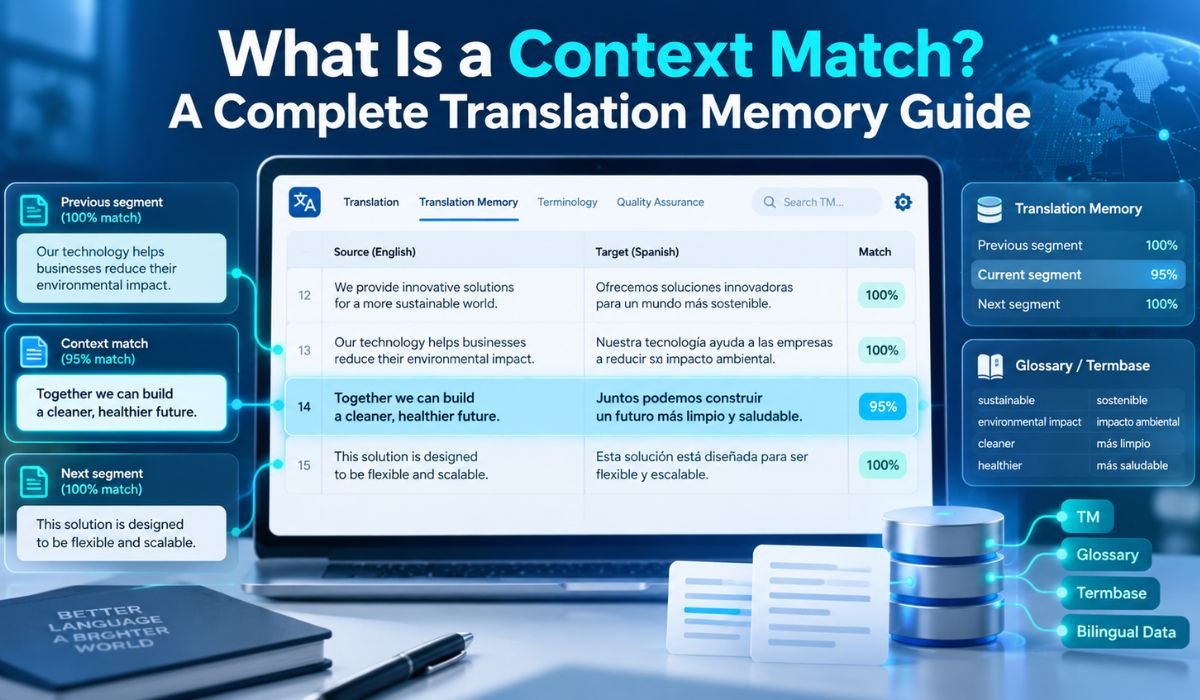
A Context Match occurs when a source segment matches previously stored source content and the contextual information required by the CAT tool also corresponds with the earlier entry.
Exactly what counts as “context” depends on the software. Some CAT tools look at the segments immediately before and after the current one. Others can rely on segment keys, IDs, document structure, or combinations of contextual signals.
Consider a simple word such as “Open.” In one part of an application, it could be a command telling someone to open a file. Somewhere else, “Open” might describe the status of a customer-support ticket. The English source text is identical, but the intended meaning is different.
An ordinary exact match tells the translator that the same source text exists in the Translation Memory. A Context Match goes further by providing evidence that the text was previously used under matching contextual conditions.
In practical terms, Context Matching isn’t a new form of translation. It’s an additional layer of verification that can make Translation Memory reuse more dependable.
How Translation Memory Supports Context Matching
To understand why Context Matches matter, it helps to look at Translation Memory itself.
A Translation Memory is a database containing previously translated source segments and their corresponding target-language translations. Depending on the CAT system and workflow, an entry may also contain metadata and information about the segment’s context.
When a translator imports new content, the CAT tool searches available Translation Memories for material that has appeared before. A similar but nonidentical segment may return a fuzzy match. Identical source content can return an exact match. If the contextual requirements defined by the system are also satisfied, the software may classify the result as a higher-confidence Context Match.
This becomes especially valuable with recurring content.
Imagine a manufacturer publishing a new edition of a product manual. Much of the manual may remain unchanged, while a few sections are rewritten, moved, or expanded. Translation Memory allows translators to reuse language from the previous edition rather than starting over. Context Matching provides another signal that an existing translation belongs in the same or an equivalent textual environment.
It’s also important to distinguish Translation Memory from Machine Translation. A TM primarily retrieves translations that were previously stored. Machine Translation, by contrast, generates a translation using a translation engine or language model. The two technologies often work alongside each other, but their roles aren’t the same.
How Does A Context Match Work?
A Context Match becomes possible when the CAT environment has useful contextual information to compare.
Suppose an earlier document contained the following sequence: “Your changes have been saved,” followed by “Continue,” and then “Return to your dashboard.”
Now imagine that the same sequence appears in a revised document. The CAT tool can recognize “Continue” as an exact source-text match. If it also determines that the contextual information surrounding the segment corresponds with the earlier entry, it may classify the translation as an in-context or higher-confidence match.
Software localization can work somewhat differently. Instead of relying primarily on neighboring text, structured files may contain identifiers or keys that tell the localization system what a particular string represents. For a short interface label, that identifier can sometimes be more informative than the sentence before or after it.
This distinction matters because Context Matching isn’t simply about checking neighboring sentences. Depending on the software and file format, context may be textual, structural, identifier-based, or a combination of these elements.
That flexibility is one reason Context Matching is useful across very different translation projects.
Context Match Vs 100% Match
The difference between a Context Match and a 100% match is one of the most important concepts to understand in Translation Memory.
At first glance, “100% match” sounds definitive. If something matches 100%, what more could a translator need?
The answer is context.
A 100% match commonly means that the current source segment corresponds exactly to a source segment already stored in the Translation Memory under the CAT tool’s matching rules. What it doesn’t necessarily establish is that the segment appears in the same context.
A Context Match adds that extra layer.
Phrase TMS, for instance, distinguishes between 100% Translation Memory matches and 101% in-context matches. memoQ also distinguishes exact matches from matches where the required stored context corresponds.
The practical difference isn’t really about whether one number looks higher than another. It’s about what the software has verified.
A standard exact match tells you that the source text has appeared before. A Context Match tells you that the text has appeared before and that the relevant contextual conditions also correspond.
That makes it a stronger reuse signal, but not an absolute guarantee that the translation is right.
Why Identical Text Can Need Different Translations
Language rarely exists in isolation. That’s why two identical English strings can require different translations.
Grammatical gender is a straightforward example. English adjectives often remain unchanged regardless of the noun they describe. In another language, the translated adjective may need to change according to whether the noun is masculine, feminine, or another grammatical category.
Case systems create similar challenges. A word may take a different form depending on its role in the surrounding sentence. If the CAT tool sees only an isolated segment, some of that grammatical information may be missing.
Then there’s meaning itself.
Take the word “Home.” On a conventional website, it will probably refer to the main page. In a smart-home application, it might refer to a physical property. In navigation software, “Home” could mean a saved destination.
The same ambiguity appears in everyday interface terms such as “Save,” “Open,” “Close,” “Back,” “Next,” and “Continue.”
Tone matters too. A casual game, a banking platform, and a medical application may use the same English command while requiring different levels of formality or clarity in another language.
Experienced translators therefore don’t judge isolated words solely by their dictionary meaning. They consider purpose, grammar, audience, tone, and surrounding content. Context Matching helps the technology support that same principle.
What Do 100%, 101%, And 102% Matches Mean?
Match percentages can become confusing once they move above 100%.
A newcomer might reasonably assume that 101% and 102% have standardized meanings across the translation industry. They don’t.
Translation Memory scoring conventions are platform-specific.
Phrase TMS uses 101% for an in-context Translation Memory match under its defined matching rules.
Smartcat documents several match levels above 100%. Its system can distinguish exact source matches according to additional factors such as adjacent context and, in supported situations, a segment key or ID.
memoQ follows its own model. It supports simple Context Matches as well as double-context matches when the required types of context are available.
As a result, a 102% match displayed in one CAT tool shouldn’t automatically be interpreted in the same way as 102% in another platform.
This is more than a technical footnote. Translators and localization managers often use match scores to determine pre-translation, review, or workflow behavior. Misunderstanding what those percentages represent can lead to inappropriate automation.
The safest approach is straightforward: check the documentation for the CAT platform and version being used, and pay attention to the matching conditions behind the score rather than the percentage alone.
Context Match, ICE Match, And PerfectMatch
Translation technology has developed its own vocabulary, and several related terms can sound interchangeable even when they aren’t.
An ICE Match, short for In-Context Exact Match, generally refers to an exact Translation Memory match that also satisfies the contextual requirements defined by the relevant system. In that sense, ICE matching is closely related to the broader idea of Context Matching.
PerfectMatch needs a more precise explanation.
Within the Trados ecosystem, PerfectMatch has been associated with leveraging previously translated bilingual documents to identify content from earlier versions. Although the objective is familiar—reusing trusted previous translations—the mechanism isn’t simply identical to an ordinary Translation Memory Context Match.
The distinction matters because localization teams may encounter all of these terms when working across platforms.
Rather than treating ICE Match, Context Match, and PerfectMatch as universal synonyms, it’s better to ask how the particular CAT system defines each feature. Translation software shares many concepts, but the terminology and implementation aren’t fully standardized.
Context Match In Popular CAT Tools
Most leading CAT platforms recognize the value of context, but they don’t all handle it in exactly the same way.
Phrase TMS supports in-context Translation Memory matches and can use contextual information according to project settings and supported file formats.
memoQ supports Context Matching using text-flow context as well as identifier-based context in relevant workflows. It can also distinguish double-context matches where applicable.
Smartcat uses several match levels above 100% to communicate additional contextual correspondence, including matching based on adjacent segments and identifiers under supported conditions.
Trados workflows likewise make use of contextual information in Translation Memory, while PerfectMatch provides a related but distinct approach based on previously translated bilingual material.
For translators working inside one platform, these differences may seem minor. They become much more important when a company migrates Translation Memories, changes CAT systems, or combines localization workflows from different vendors.
A percentage, metadata field, or context rule shouldn’t be assumed to carry precisely the same meaning after such a move. The underlying context information and platform configuration matter just as much as the number displayed in the editor.
Why Context Matching Improves Translation Quality
The real value of Context Matching isn’t a higher percentage on the screen. It’s more selective reuse.
A normal exact Translation Memory match establishes that the source content has appeared before. Context Matching adds evidence that the previous translation was used under comparable conditions. That can reduce the risk of inserting an otherwise valid translation into the wrong place.
This is particularly helpful for recurring projects. Software updates, revised technical manuals, frequently updated websites, product releases, and long-running documentation projects often contain large amounts of repeated material.
When the Translation Memory is reliable, high-confidence Context Matches can also make review more efficient. Linguists can devote more attention to new content, changed passages, ambiguous strings, and material carrying greater risk.
There is an important qualification, though: Context Matching is only as trustworthy as the translation being retrieved.
If a Translation Memory contains an error, a Context Match may reproduce that error with impressive confidence. If the terminology is outdated, context won’t magically update it. The technology can confirm similarity and context according to its rules; it cannot independently guarantee linguistic quality.
That’s why Context Matching should strengthen quality control rather than replace it.
Context Matching For Websites And Software
Context becomes especially important in website and software localization because interface strings are often short.
Imagine receiving the word “Close” without seeing the screen where it appears. Is it a command telling the user to close a window? Does it describe something nearby? Could it have another product-specific meaning?
“Book” presents a similar problem. It might be a noun referring to reading material or a verb asking someone to reserve a hotel, restaurant, or appointment.
To the person using the finished interface, the intended meaning may be obvious because the word appears alongside buttons, images, menus, and other visual clues. A translator working from an isolated string may not have those clues.
Structured localization files can help by carrying meaningful keys, IDs, developer notes, or other context. When the CAT tool and file format support this information, it can make Translation Memory matching more precise and give translators a clearer understanding of the string’s purpose.
Developers therefore play a meaningful role in localization quality. Stable, descriptive identifiers and useful comments can prevent ambiguity before it reaches the translator.
For multilingual software teams, context isn’t merely helpful background information. It’s part of good localization data.
Context Match And Brand Consistency
Translation quality isn’t only about grammatical correctness. Consistency matters as well.
A company may use the same product terms across its website, mobile application, onboarding flow, documentation, customer emails, and help center. If those terms are translated differently from one channel to another, the experience can feel fragmented and users may struggle to recognize familiar functions.
Context Matching can reduce that kind of drift by making it easier to reuse approved translations where the contextual conditions support them.
Still, Translation Memory works best as part of a broader linguistic system.
A TM records how complete segments were translated previously. A terminology database or glossary establishes preferred translations for important words and expressions. A style guide covers broader decisions such as tone, capitalization, punctuation, product naming, and brand voice.
These resources answer different questions. Used together, they give translators a much stronger foundation than any match percentage could provide on its own.
Can A Context Match Still Be Wrong?
Yes.
This is one of the most important limitations for anyone building automated workflows around Translation Memory.
A Context Match tells you that the source content and the contextual information recognized by the CAT tool correspond with previously stored material. It doesn’t independently evaluate whether the target translation itself is good.
Perhaps the original translator made an error. Maybe the company has since renamed the product. The preferred terminology could have changed, or an old legal phrase may no longer meet current requirements. A brand might also have adopted a new tone of voice since the translation entered the TM.
The source text and its context could remain exactly the same while the appropriate target translation has changed for business reasons.
That possibility deserves particular attention with medical, legal, financial, regulatory, safety-related, and other high-impact material. Review requirements should reflect the consequences of an error rather than simply the Translation Memory score.
A sensible rule for professional localization is to treat a high match score as strong evidence for reuse, not proof of correctness.
Why A Context Match May Not Appear
Sometimes a translator knows that a sentence appeared in an earlier version of a document, yet the CAT tool doesn’t return the Context Match they expected.
That doesn’t necessarily mean anything is broken.
Perhaps one of the surrounding segments has changed. The content may have moved to another part of the document. A software string might now have a different identifier. The Translation Memory could have been imported from another platform without all of the original contextual information.
Segmentation can also affect results. If one system divides source content differently from another, the resulting Translation Memory segments may no longer align in the same way. Tags, formatting, file structure, and project settings can introduce additional differences.
TM migration deserves particular attention. Source and target text can transfer successfully between systems while platform-specific context behaves differently in the new environment.
When an expected Context Match is missing, it’s worth examining the neighboring content, segment IDs, tags, segmentation rules, file format, Translation Memory configuration, and available context metadata before concluding that the translation has disappeared.
Best Practices For Reliable Context Matching
Good Context Matching begins long before a match appears on the translator’s screen. It starts with the quality of the Translation Memory itself.
A TM shouldn’t become a permanent dumping ground for every translation ever produced. Incorrect entries, outdated terminology, obsolete product names, and inconsistent language reduce its value over time. Regular maintenance makes future reuse more dependable.
Context should also be preserved whenever the file format and localization platform support it. In software projects, stable and meaningful identifiers can be particularly valuable. Constantly changing or meaningless string keys make it harder for localization systems and translators to understand how content relates across versions.
Automation rules deserve the same care. Automatically inserting a high-confidence Translation Memory result isn’t necessarily the same as approving that result without review. Teams should decide separately which matches can be pre-translated, which can be locked or confirmed, and which still require linguistic verification.
The level of review should also reflect risk. A repeated menu label and a repeated medical warning may both receive strong Translation Memory matches, but the consequences of an error aren’t comparable.
Above all, localization teams should understand the matching logic of the CAT tool they actually use rather than applying assumptions learned from another platform.
Context Matching, AI, And The Future Of Localization
By 2026, Translation Memory rarely operates in isolation. Modern localization environments increasingly combine TM data with Machine Translation, terminology databases, automated quality checks, workflow automation, and AI-assisted language tools.
Far from making context less important, this shift makes reliable context more valuable.
Automation can process huge volumes of content quickly, but short and ambiguous strings remain difficult when the system lacks information about their purpose. A translation engine may know several possible meanings of “Save,” for example, yet still need product or interface context to determine which meaning applies.
Richer localization workflows can provide that information through document structure, string identifiers, previous translations, terminology, developer notes, and other metadata. As translation technology develops, these signals can help systems make better decisions about when existing language is safe to reuse and when human attention is needed.
Translation Memory also retains an important advantage: it represents an organization’s accumulated translation history. Properly maintained, it records language that has already been reviewed, approved, and used in real products or documents.
AI can complement that resource, but it doesn’t eliminate the value of reliable historical translations and well-preserved context.
The principle behind Context Matching therefore remains remarkably durable: words make more sense when we know where, why, and how they’re being used.
Final Thoughts
A Context Match adds something important to Translation Memory: evidence about where and how previously translated language was used.
Instead of asking only, “Have we translated these words before?” contextual matching allows a CAT tool to ask a more useful question: “Have we translated these words before under matching contextual conditions?”
That difference can have a real impact on professional localization. It helps translators handle recurring documentation, software updates, websites, interface strings, and other repeated content with greater confidence. It can also support consistency and reduce time spent retranslating material that has already been approved.
The percentages shouldn’t become the main story, though.
A 100%, 101%, or 102% result only makes sense within the matching rules of the CAT platform that produced it. Phrase, memoQ, Smartcat, Trados, and other translation environments don’t necessarily define context or match levels in precisely the same way.
More importantly, no percentage can transform a poor Translation Memory entry into a good translation.
The most dependable localization workflows combine clean Translation Memories with meaningful contextual data, terminology management, clear style guidance, sensible automation, quality assurance, and professional human judgment.
When those pieces work together, Context Matching becomes more than a convenient CAT-tool feature. It becomes a practical way to reuse translation intelligently while preserving the meaning, consistency, and clarity that multilingual readers expect.
FAQs About Context Match
What Is A Context Match In Translation?
A Context Match is a Translation Memory result in which the current source segment corresponds with previously stored source content and the contextual conditions required by the CAT system also match. Depending on the platform, that context may involve neighboring segments, an identifier, document structure, or another supported signal. Because more than the source text has been verified, the result generally provides greater confidence for translation reuse than an exact text match alone.
What Is The Difference Between A Context Match And A 100% Match?
A 100% match generally tells the translator that the source segment is identical to an entry stored in the Translation Memory under the software’s matching rules. A Context Match adds contextual verification. That might involve matching surrounding segments or an appropriate segment identifier. The precise criteria depend on the CAT platform, so a 100% result shouldn’t automatically be interpreted as contextually identical.
What Does A 101% Translation Memory Match Mean?
There isn’t one universal definition. Phrase TMS uses 101% for an in-context Translation Memory match. memoQ also uses 101% for its simple Context Match, while Smartcat applies 101% according to its own adjacent-context matching rules. The percentage is therefore meaningful only when interpreted according to the CAT tool that produced it.
What Does A 102% Match Mean?
A 102% match is also platform-specific. Smartcat can use 102% when an exact source match has the required correspondence with both adjacent segments, while memoQ uses 102% for its double-context model. Because the underlying rules differ, 102% shouldn’t be presented as a universal translation-industry standard.
Is A Context Match Always Correct?
No. Context Matching verifies particular source and context conditions; it doesn’t independently judge the quality of the target translation. An old Translation Memory may contain mistakes, outdated terminology, obsolete product names, or language that no longer follows current requirements. High-confidence matches can still require human review when the content or risk justifies it.
Why Am I Not Getting A Context Match?
Several factors can prevent an expected Context Match. Surrounding segments may have changed, a segment ID might be different, the content may have moved, or contextual metadata may not be available. Changes in segmentation, tags, file structure, Translation Memory migration, and project settings can also affect the result. Checking these elements is usually more useful than looking only at the source sentence.
Is Context Matching Useful For Software Localization?
Yes. Software contains many short strings whose meaning can be unclear without context. Segment keys, identifiers, developer comments, interface information, and neighboring content can help distinguish identical words used for different purposes. When the file format and CAT platform support that information, Context Matching can make translation reuse much more reliable.
Do Context Matches Need Human Review?
It depends on the project. A well-maintained Translation Memory and a strong Context Match can support substantial automation, particularly for low-risk repeated content. However, medical, legal, financial, safety-related, regulatory, or other business-critical translations may still require professional review. The decision should be based on Translation Memory quality, content risk, and project requirements rather than match percentage alone.
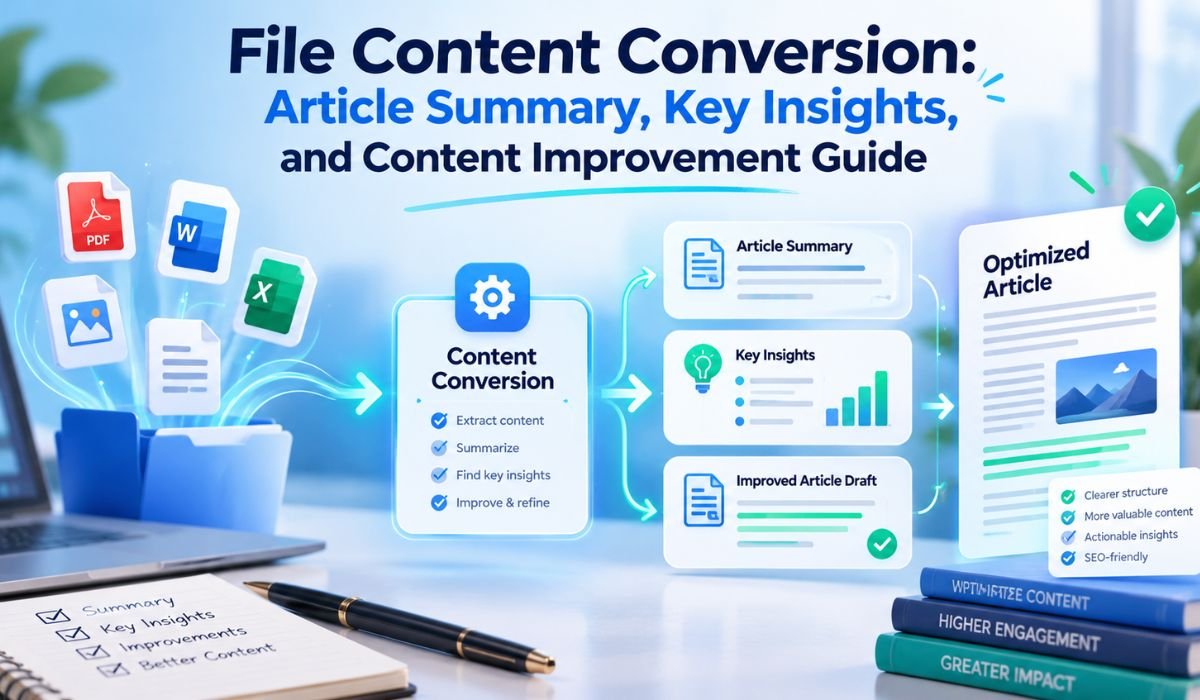
Learn more and explore exciting content on: File Content Conversion: Article Summary, Key Insights, and Content Improvement Guide









Leave a Reply