
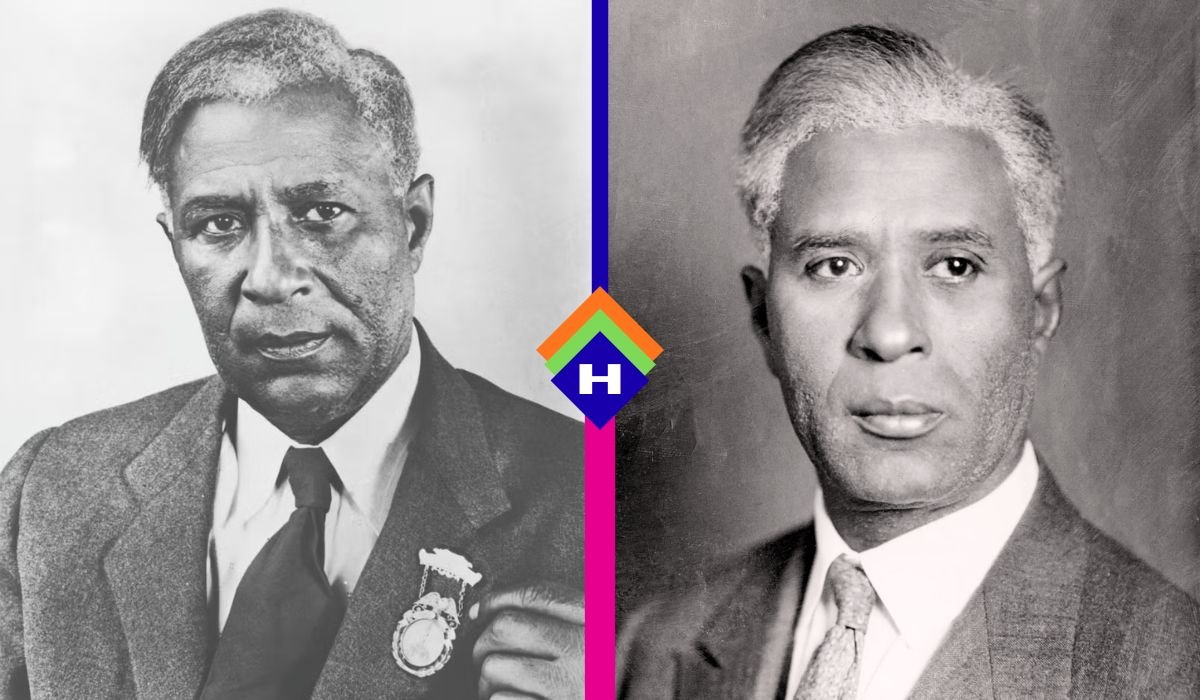
Garrett Morgan Was The Kind Of Inventor Who Saw A Problem And Wanted To Fix It. He Wasn’t Content To Accept That Something Was Dangerous, Inefficient, Or Simply Could Work Better. That Mindset eventually led him to develop inventions that influenced traffic safety and protective breathing equipment.
Born In Kentucky In 1877, Morgan went on to build a remarkable career in Cleveland, Ohio, as an inventor, entrepreneur, publisher, and community leader. He’s best known for the three-way traffic signal he patented in 1923 and the safety hood he patented in 1914. The safety hood was designed to help people breathe in environments filled with smoke and dangerous gases.
Morgan’s achievements are even more remarkable when his background is considered. He had limited formal schooling, yet he developed strong mechanical skills through experience, experimentation, and self-directed learning. He also built successful businesses and used his resources to support his community.
At the same time, Morgan had to work through the racial discrimination that confronted Black Americans in the early 20th century. His career, therefore, wasn’t simply a story of invention. It was also a story of persistence, entrepreneurship, courage, and finding opportunities in circumstances that often weren’t fair.
Quick Bio Information
Full Name: Garrett Augustus Morgan
Born: March 4, 1877
Birthplace: Paris, Kentucky
Died: July 27, 1963
Age At Death: 86
Parents: Sydney Morgan And Eliza Reed
Siblings: Seventh Of 11 Children
First Wife: Madge Nelson
Second Wife: Mary Hasek
Children: John P. Morgan, Garrett A. Morgan Jr., And Cosmo H. Morgan
Main Base: Cleveland, Ohio
Occupation: Inventor, Entrepreneur, Businessman, And Publisher
Famous Inventions: Safety Hood And Three-Way Traffic Signal
Safety Hood: Introduced In 1912 And Patented In 1914
Traffic Signal Patent: 1923
Hair-Care Company: G. A. Morgan Hair Refining Co.
Newspaper: Cleveland Call
Traffic Signal Patent Sale: $40,000 To General Electric
National Inventors Hall Of Fame: Inducted In 2005
Burial Place: Lake View Cemetery In Cleveland, Ohio
Garrett Morgan’s Early Life And Family Background
Garrett Augustus Morgan was born in Paris, Kentucky, on March 4, 1877. He was the seventh of 11 children and grew up in a family whose history was closely tied to the difficult period following the Civil War.
His parents, Sydney Morgan and Eliza Reed, had both previously been enslaved, according to the Encyclopedia of Cleveland History. As a teenager, Morgan left home and moved to Cincinnati, hoping to find better educational and financial opportunities. He used some of the money he earned to hire a tutor and continue his education.
That part of Morgan’s story is worth remembering because he didn’t have the benefit of an extensive formal education. Much of what he eventually learned came from experience. He watched how machines worked, figured out how to repair them, experimented with new ideas, and gradually developed the practical skills that would define his career.
In 1895, Morgan moved to Cleveland. The city would become his home for the rest of his life and the place where many of his most important ideas took shape.
From Sewing-Machine Repairman To Successful Businessman
Morgan’s interest in invention grew naturally from his work with sewing machines. He learned how the machines operated and became skilled at identifying problems and making repairs. Before long, his mechanical abilities began producing ideas of his own.
One of his early inventions involved a belt fastener for sewing machines. His experience eventually gave him enough confidence to establish a business of his own.
In 1907, Morgan opened a business repairing and selling sewing machines. Two years later, he established a tailoring shop. His wife, Mary Hasek, worked as a seamstress, while Morgan’s mechanical knowledge helped keep the shop’s equipment operating properly.
This period was an important turning point. Morgan wasn’t simply learning how to invent; he was learning how to run a business. That combination would become one of his greatest strengths. He understood that an invention had to solve a real problem, but he also understood that it needed to be marketed and sold if it was going to succeed.
Garrett Morgan’s Hair-Refining Business
One of Morgan’s most successful business ventures grew out of an unexpected observation.
While experimenting with a liquid intended to prevent sewing-machine needles from burning fabric, Morgan noticed that the solution could also straighten hair. Rather than dismissing the discovery as an accident, he began experimenting with it.
Those experiments eventually led to the G. A. Morgan Hair Refining Co., which he organized in 1913. The company produced hair-care products and became an important source of Morgan’s financial success.
The business mattered for another reason, too. Its profits gave Morgan greater freedom to pursue his other interests. He no longer had to rely entirely on an employer to provide the resources for experimentation. His own business could help finance the next invention.
That relationship between entrepreneurship and invention would remain a recurring theme throughout his career.
The Safety Hood That Changed Rescue Work
Morgan’s safety hood became one of his most significant inventions. The idea was rooted in a serious problem faced by firefighters and other workers: how to breathe safely in environments filled with smoke and dangerous gases.
The 1911 Triangle Shirtwaist Factory fire in New York, which killed 146 garment workers, helped reinforce Morgan’s interest in developing better respiratory protection. He introduced his breathing device in 1912 and filed for a patent that year. The patent was granted in 1914.
Morgan also established the National Safety Device Co. in 1914 to market the invention. He didn’t simply rely on written descriptions to convince customers. He actively demonstrated the device and promoted it to firefighters and others who might need protection in hazardous environments.
The safety hood is often described as an early forerunner of the gas mask. That’s a more accurate description than saying Morgan invented the modern gas mask. His device represented an important development in protective breathing equipment and demonstrated his ability to turn a dangerous real-world problem into a practical invention.
Garrett Morgan And Racial Discrimination
Morgan’s technical abilities didn’t shield him from racial discrimination.
As a Black inventor and businessman working in the early 20th century, he sometimes encountered potential customers who were reluctant to buy his products because of his race. His safety hood presented an especially difficult marketing challenge because Morgan needed fire departments and other organizations to trust equipment that could literally be used in life-threatening situations.
The National Inventors Hall of Fame records that Morgan changed his marketing strategy, including using white actors to promote the product at conventions. He also marketed the device under the name “Morgan Safety Hood.”
These details provide important context for understanding his success. Morgan wasn’t competing in a marketplace where everyone was judged solely on the quality of an invention. Racial prejudice could influence how customers viewed both him and his products.
Rather than giving up, he looked for practical ways to get his technology in front of potential buyers. That determination became an important part of his story.
The 1916 Cleveland Waterworks Tunnel Disaster
The real test of Morgan’s safety hood came in 1916.
On July 25, a natural gas explosion occurred while workers were constructing a waterworks tunnel beneath Lake Erie. The disaster created an extremely dangerous environment underground, and subsequent rescue attempts also cost lives.
Historical accounts differ somewhat in how the death toll is presented, but Cleveland Historical records that the explosion and rescue efforts ultimately resulted in 20 deaths involving workers and rescuers.
Morgan and his brother Frank were among those who entered the gas-filled tunnel using Morgan’s breathing device. The equipment gave them protection in an environment where smoke, dust, and poisonous gases had already made rescue extremely difficult.
Morgan and the other rescuers helped bring survivors out and recover the bodies of people who had died. The episode provided a dramatic real-world demonstration of what his invention could do.
The safety hood was no longer simply something Morgan was trying to sell. It had been used in an actual emergency in which breathing normally could have been fatal.
Why Morgan’s Rescue Was Not Fully Recognized
Given the danger of the rescue, it would be reasonable to expect Morgan to have received widespread public recognition. Instead, his contribution was complicated by the racial attitudes of the time.
Several rescuers showed extraordinary courage during the disaster, and Morgan’s role was important. Yet the recognition he received wasn’t equal to that given to some white rescuers. According to Cleveland Historical, four white rescuers later received Carnegie Medals, while Cleveland did not support Morgan’s nomination for the same honor.
The episode illustrates how racial discrimination could affect not only opportunities but also the historical record. Morgan’s actions were not always given the prominence they deserved.
There was another painful consequence. The publicity surrounding the rescue made Morgan’s identity as a Black inventor more widely known. Some customers subsequently refused to purchase his safety equipment because of his race, hurting the business he had worked so hard to build.
The episode remains one of the clearest examples of the obstacles Morgan faced even when his invention had proved its value in a life-or-death situation.
Garrett Morgan And The Three-Way Traffic Signal
Morgan’s most famous invention came from another problem that was becoming increasingly difficult for growing American cities: traffic.
By the 1920s, automobiles were becoming more common, and busy streets had to accommodate cars, horse-drawn vehicles, pedestrians, and other road users. Traffic control was becoming a major safety issue.
According to the National Inventors Hall of Fame, Morgan witnessed a collision involving a horse-drawn carriage and another vehicle at a Cleveland intersection. The experience helped inspire him to look for a better way to control traffic.
In 1923, he patented a mechanical three-way traffic signal. Its most important feature was a caution position between stop and go.
That third position gave traffic a controlled transition. Vehicles already in an intersection had time to clear it before traffic from another direction began moving. The system also created a safer pause for pedestrians and other road users.
Morgan’s invention wasn’t simply about telling drivers when to stop and when to go. It was about managing the transition between those two actions.
How Garrett Morgan’s Traffic Signal Worked
Morgan didn’t invent the first traffic signal. Traffic-control systems existed before his patent. His contribution was a specific improvement: a three-position signal that included a warning stage.
The National Inventors Hall of Fame describes Morgan’s caution signal as the equivalent of today’s yellow light. His patented design could stop traffic in all directions before allowing movement in another direction.
The distinction is important. Saying that Morgan “invented the traffic light” can make the history sound much simpler than it actually was. A more precise description is that he patented an important improvement to traffic signals that helped shape the development of modern intersection control.
That improvement addressed a straightforward but significant problem. Traffic needed a safer transition when the right of way changed. Morgan’s design provided one.
Morgan’s Traffic Signal Patent And General Electric Deal
Morgan’s traffic-signal invention had both practical and commercial value. He secured patent protection for the design and eventually sold his patent rights to General Electric for $40,000 in 1923.
General Electric later developed an electric version of the three-way signal. For Morgan, the sale represented another successful example of turning an idea into a commercially valuable invention.
The deal also showed how far his career had come. He had started out learning to repair sewing machines and had eventually developed technology that addressed a growing problem in modern cities.
Morgan was inducted into the National Inventors Hall of Fame in 2005, further cementing his place in American invention history. His safety hood and traffic signal remain the inventions most closely associated with his name.
Garrett Morgan’s Other Inventions And Mechanical Ideas
Morgan’s career wasn’t limited to the two inventions that made him famous.
His early mechanical work included improvements related to sewing machines, while his later interests extended to automobiles and other everyday equipment. He developed a friction-drive clutch and explored various mechanical ideas throughout his career.
His interest in automobiles was understandable. Cars were transforming American cities during his lifetime, and Morgan was fascinated by the technology around him. His work reflected a broader habit of looking at new machines and asking how they could be improved.
Even in his later years, he continued experimenting. One of his later ideas was a self-extinguishing cigarette that used a water-filled plastic pellet near the filter.
Not every idea became widely used, and not every invention had the impact of his traffic signal. But taken together, his work reveals something important about Morgan: he was constantly looking for practical solutions rather than waiting for a single breakthrough to define him.
Garrett Morgan’s Wife And Children
Morgan was married twice.
His first marriage was to Madge Nelson in 1896, but the couple divorced in 1898. Far more is known about Morgan’s second marriage.
In 1908, he married Mary Hasek, who was of Czech immigrant background. The couple had three children: John P. Morgan, Garrett A. Morgan Jr., and Cosmo H. Morgan.
Their interracial marriage also brought social challenges. Morgan and Mary lived during a period when interracial relationships faced strong opposition, adding another layer of difficulty to their family life.
Morgan placed considerable importance on education for his children. His own limited formal schooling had not prevented him from building a remarkable career, but he wanted his sons to have opportunities that had been less accessible to him.
His family life provides a quieter side of the inventor’s story. Away from patents and business deals, Morgan was a husband and father who wanted his children to have a strong educational foundation.
Garrett Morgan As A Community Leader
Morgan’s influence extended well beyond his inventions.
He became involved in Cleveland’s African American community and supported civic and educational causes. He helped found the Cleveland Association of Colored Men in 1908, an organization that contributed to the development of Black civic leadership in Cleveland.
He also supported Black educational institutions and remained active in community affairs.
In 1920, Morgan helped establish the Cleveland Call, an African American weekly newspaper. The publication later became part of the Cleveland Call & Post and developed into an important Black newspaper in Cleveland.
This side of Morgan’s life is easy to overlook when the focus is placed on the traffic signal. Yet it tells us something significant about what he did with his success. He wasn’t solely interested in building his own fortune. He also invested time and resources in strengthening the community around him.
Garrett Morgan’s Later Years And Health
Morgan continued working on new ideas even as his health declined.
He developed glaucoma later in life and eventually lost much of his sight. He also experienced other health problems. Morgan believed that some of his health difficulties were connected to exposure to dangerous substances during the 1916 tunnel rescue.
That connection should be understood as Morgan’s own belief rather than a definitively established medical cause.
Despite his health challenges, Morgan continued to receive recognition for his contributions. In 1963, he was honored as a pioneering citizen at an Emancipation Centennial celebration for his contributions to public safety and his community.
Morgan died in Cleveland on July 27, 1963, at the age of 86. He was buried at Lake View Cemetery in Cleveland.
By the time of his death, he had lived through enormous changes in American technology, transportation, business, and civil rights. His career had stretched from the era of sewing machines and horse-drawn vehicles into the age of automobiles and modern urban traffic.
Garrett Morgan’s Lasting Legacy
Morgan’s legacy has continued to grow since his death.
In 2005, he was inducted into the National Inventors Hall of Fame, recognizing the lasting significance of his inventions. His name has also been attached to educational institutions and public facilities, helping introduce new generations to his work.
The Garrett A. Morgan Water Treatment Plant in Cleveland was rededicated in his honor in 1991. The recognition was particularly fitting because of the connection between his name and the 1916 waterworks disaster.
Schools and educational programs have also carried his name, ensuring that his story remains part of American educational history.
Perhaps the strongest part of Morgan’s legacy, however, isn’t any single patent. It’s the way he approached problems.
He saw dangerous traffic and designed a safer traffic-control system. He saw the risks faced by firefighters and developed protective breathing equipment. He built businesses around his ideas, supported his community, and continued working despite obstacles that would have discouraged many people.
That combination of invention, entrepreneurship, and civic responsibility is what makes his story endure.
Final Thoughts
Garrett Morgan’s story is bigger than the traffic signal that made his name famous.
He was a practical problem solver who turned mechanical skills into successful businesses and patented inventions. His safety hood demonstrated the value of protective breathing equipment in dangerous rescue situations, while his three-way traffic signal introduced an important warning stage that helped make intersection control safer.
His achievements become even more meaningful when viewed against the racial barriers of his time. Morgan had to navigate prejudice while selling products, seeking recognition, and building businesses. Yet he kept experimenting, investing in his community, supporting education, and looking for ways to improve everyday life.
That’s why Garrett Morgan remains relevant in 2026. His work isn’t simply a piece of invention history. It offers a lesson in how useful innovation often begins: someone notices a problem that others have learned to live with and decides that it doesn’t have to stay that way.
The traffic signal may be the invention most people remember. But Morgan’s larger legacy is the determination behind it.
FAQs About Garrett Morgan
What Was Garrett Morgan Famous For?
Garrett Morgan was best known for his safety hood and three-way traffic signal. His safety hood, introduced in 1912 and patented in 1914, was designed to help protect people from smoke and harmful gases. His 1923 traffic signal added a caution position between stop and go, an important improvement in traffic control.
Did Garrett Morgan Invent The Traffic Light?
Morgan did not invent the first traffic signal. Earlier traffic-control systems already existed. His major contribution was a three-way signal patented in 1923 that added a caution stage between stop and go. This allowed traffic to be stopped before movement changed and gave vehicles more time to clear an intersection.
What Did Garrett Morgan Invent In 1914?
Morgan patented his safety hood in 1914. He had introduced the breathing device in 1912 and later established the National Safety Device Co. to market it. The device was designed to help users breathe in environments containing smoke and harmful gases and is considered an early forerunner of later gas-mask technology.
Did Garrett Morgan Rescue People In The 1916 Tunnel Disaster?
Yes. During the 1916 Cleveland Waterworks Tunnel Disaster, Morgan and his brother Frank entered the gas-filled tunnel using Morgan’s breathing device. Their equipment allowed them to enter an environment that had already overwhelmed other rescuers. Morgan and other rescuers helped bring survivors out and recover those who had died.
Who Was Garrett Morgan’s Wife?
Garrett Morgan married Madge Nelson in 1896, but they divorced in 1898. He later married Mary Hasek in 1908. Mary was of Czech immigrant background, and the couple had three children: John P. Morgan, Garrett A. Morgan Jr., and Cosmo H. Morgan.
How Many Children Did Garrett Morgan Have?
Garrett Morgan had three children with Mary Hasek: John P. Morgan, Garrett A. Morgan Jr., and Cosmo H. Morgan. Morgan valued education and wanted his children to have opportunities that had been less available to him during his own childhood.
When Did Garrett Morgan Die?
Garrett Morgan died on July 27, 1963, in Cleveland, Ohio, at age 86. He was buried at Lake View Cemetery in Cleveland. His death came after a long life spent developing inventions, building businesses, supporting his community, and contributing to public safety.
Why Is Garrett Morgan Important Today?
Garrett Morgan remains important because his work connected invention with everyday safety. His three-way traffic signal helped improve traffic control, while his safety hood advanced protective breathing equipment. His business achievements and community work also demonstrated what a Black entrepreneur could accomplish during a period of severe racial inequality. His 2005 induction into the National Inventors Hall of Fame further recognized his place in American innovation history.
Learn more and explore exciting content on: Trump Age: How Old Is Donald Trump in 2026? A Look at His Life, Family, and Career













Leave a Reply