
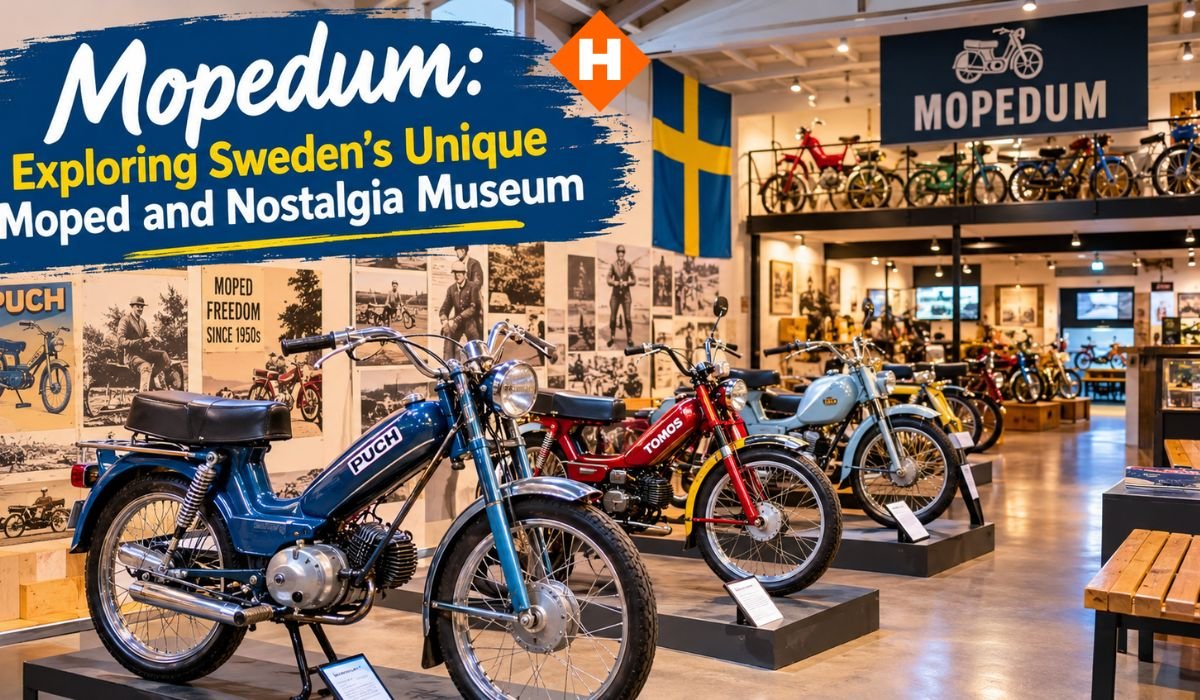
For anyone interested in vintage vehicles, Swedish culture, or the everyday details of life in decades past, Mopedum offers a fascinating story. The former museum in Nynäshamn, Sweden, wasn’t simply a place where old mopeds were lined up for visitors to admire. It was designed as an immersive journey through Swedish life, with mopeds serving as the thread connecting different periods, places, and experiences.
Known as Mopedum – Svenska Nostalgimuseet, the museum focused mainly on the years from 1952 to 1979, a period it described as the moped’s “golden age.” Its displays combined vintage mopeds with furniture, clothing, household objects, shops, kitchens, and other carefully arranged scenes. A visitor could move from one recreated environment to another and get a sense of how Swedish homes, transportation, shopping, and youth culture changed over several decades.
The original Mopedum Museum closed permanently in December 2022. However, its story didn’t end when the doors closed in Nynäshamn. Vällingby Centrum in Stockholm later purchased the contents of the collection and a number of its mopeds from creators Nisse and Lotta Skogmyr. Parts of that collection now live on through a Nostalgimuseum display at the shopping center.
Quick Bio Information
Museum Name: Mopedum – Svenska Nostalgimuseet
Country: Sweden
Original Town: Nynäshamn
Former Address: Vikingavägen 39, Nynäshamn
Museum Type: Private Nostalgia Museum
Opening Year: 2012
Closing Year: 2022
Main Historical Period: 1952–1979
Main Theme: Swedish Mopeds And Everyday Life
Creators: Nisse Skogmyr And Lotta Skogmyr
Original Building: Former Public Indoor Swimming Hall
Main Collection: Vintage Swedish And European Mopeds
Other Material: Clothing, Furniture, Household Objects, Toys And Period Interiors
Historical Themes: Transportation, Consumer Culture, Youth Culture And Everyday Swedish Life
Current Original Status: Permanently Closed
Former Mopedum Collection: Partly Preserved At Vällingby Centrum
Current Display Name: Nostalgimuseum
Current City: Stockholm
Associated Event: Mopedumrundan
What Was Mopedum?
Mopedum was a privately created Swedish nostalgia museum in Nynäshamn that explored the country’s moped history alongside the everyday world surrounding those vehicles. Its central timeline ran from 1952 to 1979, allowing visitors to follow changes in moped design while also seeing how Swedish society was changing around them.
That combination was one of Mopedum’s defining features. Instead of treating each vehicle as an isolated historical object, the museum placed mopeds within recreated environments. Homes, shops, clothing, furniture, toys, and other everyday items helped put the vehicles into context.
Material published during the museum’s final operating year described the moped’s development as a continuous thread running through the exhibition. The journey included the 1967 transition from left-hand to right-hand traffic and continued into the cultural and youth movements of the late 1960s and 1970s.
As a result, Mopedum appealed to more than dedicated moped collectors. Visitors interested in Swedish design, transportation, family life, fashion, consumer culture, and social history could all find something relevant in the collection.
Archived visitor reviews also describe the museum as much broader than a conventional vehicle exhibition. Visitors recalled seeing toys, household goods, interiors, sports-related objects, and other pieces of everyday life. Those reviews reflect individual experiences rather than formal museum records, but they help show how the attraction was perceived during its operating years.
Who Created Mopedum?
Mopedum was created by Nisse Skogmyr and Lotta Skogmyr, whose personal interest in vintage mopeds eventually developed into a full museum project.
Nisse’s own collection formed an important foundation for the exhibition. Rather than keeping the vehicles solely as private collector’s items, the couple created an environment where visitors could see them as part of a larger story about Sweden.
Their personal involvement remained an important part of Mopedum’s identity. Even during the museum’s final years, Nisse Skogmyr was involved in introducing visitors to the collection. A 2022 event organized by the Nynäshamn Rotary Club, for example, included a visit to Mopedum where Skogmyr was scheduled to explain the museum before guests toured the exhibits.
The connection between the Skogmyrs and the collection continued after the museum closed. When the couple decided to retire, Vällingby Centrum purchased the contents of the nostalgia collection along with a number of the museum’s mopeds.
When Did Mopedum Open?
Mopedum opened in 2012 and remained in operation for roughly a decade. Its formal inauguration took place on May 26, 2012, marking the beginning of what would become a distinctive attraction in Nynäshamn.
The museum’s physical setting played an important role in making the exhibition possible. It operated inside a former public indoor swimming hall at Vikingavägen 39. The building offered enough space for the founders to create complete historical scenes rather than relying only on traditional museum cases or individual vehicle displays.
Mopedum was still welcoming organized visitors during 2022, its final year. Information published that year described the museum’s 1952–1979 timeline and the various period environments that guests could explore.
Today, those historical visitor accounts need to be read in context. They describe what Mopedum was like when it was operating and shouldn’t be taken as evidence that the original museum remains open.
Where Was Mopedum Located?
The original Mopedum Museum was located at Vikingavägen 39 in Nynäshamn, Sweden. The coastal town lies south of Stockholm and is closely associated with the Stockholm archipelago and ferry connections.
For the museum’s founders, the former swimming hall provided an unusual but practical exhibition space. Its size allowed them to recreate rooms, shops, and other environments at a much larger scale than would have been possible in a small conventional gallery.
The address is still useful for historical searches, but it’s important to understand what it represents today. Vikingavägen 39 was the location of the former Mopedum Museum; it isn’t the address of a currently operating Mopedum attraction.
That distinction matters because older travel pages and archived visitor reviews can still appear in search results. Someone researching a trip to Nynäshamn could easily mistake historical information for current opening information.
What Did Mopedum Display?
Vintage mopeds were unquestionably at the heart of Mopedum, but they weren’t the whole story.
The museum surrounded its vehicles with objects that helped recreate the atmosphere of earlier decades. Visitors could encounter clothing, furniture, toys, household items, and period interiors alongside the mopeds.
Information published during the museum’s final year referred to a 1950s kitchen, a Nynäshamn petrol station, and a small shop. Other parts of the exhibition followed cultural and social changes through the 1960s and 1970s.
This approach gave the collection two connected stories. The mopeds demonstrated changes in transportation, manufacturing, and design, while the surrounding objects showed what everyday life looked like during the same period.
That context is what made Mopedum different from a collection focused solely on mechanical history. A visitor didn’t have to recognize every manufacturer or understand the technical details of each model to appreciate what the exhibition was trying to communicate.
Inside Mopedum’s Recreated Swedish Environments
The recreated environments were among the museum’s most memorable features. Rather than arranging everything in a simple chronological row, Mopedum created scenes designed to resemble places people might actually have encountered.
One of the settings represented a 1952 country store, establishing the beginning of the museum’s central timeline. Other displays recreated aspects of a 1950s kitchen, a Nynäshamn petrol station, and a small shop.
The exhibition then moved through later decades. Its story included Sweden’s change to right-hand traffic in 1967 and continued into the youth and cultural movements that shaped the late 1960s and 1970s.
The same philosophy can still be seen in the surviving displays at Vällingby Centrum. The current Nostalgimuseum includes a traditional shop, a 1950s Swedish folkhem kitchen, a 1960s hair salon, and a 1970s children’s room with Dunderklumpen wallpaper.
Those details show why Mopedum was described as a nostalgia museum. The goal wasn’t simply to preserve individual objects. It was to recreate the surroundings in which those objects had meaning.
Sweden’s Moped Golden Age
Mopedum’s main historical timeline covered 1952 to 1979, which the museum’s visitor material described as the moped’s golden age.
This period provides useful context for understanding why the museum’s subject was so closely connected to everyday life. Mopeds became an important form of mobility and were particularly associated with affordable transportation, work, leisure, and young people’s independence.
As Sweden changed during the postwar decades, so did the cultural setting around the moped. Vehicle designs evolved, consumer habits shifted, homes changed, and youth culture developed new styles and interests.
Mopedum brought those developments together. Instead of treating transportation history as something separate from social history, it presented the two as parts of the same story.
That approach gives the museum’s collection a wider historical value. A moped can tell us about engineering and mobility, but when it is displayed alongside a period kitchen, shop, or item of clothing, it can also help illustrate the society that used it.
The Vintage Moped Collection
The former Mopedum collection included vintage mopeds from Sweden and other European countries. The portion that has been preserved at Vällingby Centrum includes vehicles from 1952 to 1979.
Among the manufacturers represented in the current Stockholm display are Crescent, Husqvarna, Monark, Fram, and Victoria.
It’s important, however, to distinguish the current selection from the original collection. The Vällingby exhibition represents part of what was once displayed at Mopedum rather than a complete transfer of every vehicle that appeared in the Nynäshamn museum.
That distinction helps avoid a common misunderstanding about what happened after Mopedum closed. The museum’s original collection wasn’t simply moved intact to Stockholm. Instead, Vällingby Centrum acquired the contents of the nostalgia collection and a number of its mopeds, creating a new public display from the material.
The surviving vehicles now form part of a wider historical presentation. They are shown alongside recreated environments, allowing visitors to see the mopeds as products of a particular period rather than simply as collectible machines.
More Than Mopeds
The name Mopedum naturally suggests a specialist vehicle museum, but the visitor experience was considerably broader.
Archived reviews from the museum’s operating years mention household objects, toys, furniture, sports-related items, interiors, and other pieces connected with everyday life. Visitors also remembered the museum’s café, which added a more relaxed element to the experience.
This broader approach helped make the collection accessible to people who weren’t experts in vintage mopeds. Someone could walk through a recreated room and recognize a familiar piece of furniture or a style of clothing without knowing anything about the mechanics of the vehicle displayed nearby.
That balance between specialist collection and familiar everyday objects was one of the museum’s most appealing characteristics. Mopedum could satisfy collectors while still giving casual visitors plenty to explore.
The result was a museum experience that connected transportation, design, consumer culture, family life, and nostalgia without requiring visitors to be specialists in any one of those subjects.
When Did Mopedum Close?
The original Mopedum Museum closed permanently in December 2022, ending approximately ten years of operation in Nynäshamn.
Information from the museum’s final year documents that it was still welcoming visitors in 2022. Later attraction records identify the original Nynäshamn site as permanently closed.
The closure was connected with the retirement of the museum’s creators, Nisse and Lotta Skogmyr. Their departure from the museum’s day-to-day operation didn’t necessarily mean that the collection had to disappear.
Instead, part of the collection found a new home. Vällingby Centrum purchased the contents of the nostalgia collection along with a number of mopeds, allowing many of the recreated environments and historical objects to remain accessible to the public.
That transition is an important part of the Mopedum story. The museum itself ended, but its material legacy continued elsewhere.
What Happened To The Mopedum Collection?
After Mopedum closed, Vällingby Centrum in Stockholm purchased the contents of the collection and a number of its mopeds.
The move gave the recreated environments a new setting. Rather than placing everything inside a single traditional museum building, the historical displays were installed throughout the shopping center’s passages.
Vällingby Centrum’s current Nostalgimuseum includes five display areas. The surviving exhibition features a dedicated moped display as well as several recreated environments representing different parts of Swedish life.
The center’s moped display includes Swedish and European models from 1952 to 1979, with Crescent, Husqvarna, Monark, Fram, and Victoria among the manufacturers represented.
Other surviving environments include a traditional shop, a 1950s kitchen, a 1960s hair salon, and a 1970s children’s room. The result is a collection that still reflects Mopedum’s original interest in everyday Swedish culture.
This is why it’s more accurate to describe the Stockholm exhibition as a continuation of part of Mopedum’s collection rather than as the reopening of the original museum.
Can You Visit Mopedum Today?
If you’re looking for the original Mopedum Museum in Nynäshamn, it isn’t open. The museum permanently closed in December 2022.
This can be confusing for travelers because historical reviews and older attraction listings remain available online. Some of those pages describe opening hours or visitor experiences from the period when Mopedum was operating. They shouldn’t be treated as current information.
There is, however, still something for Mopedum enthusiasts to see in Stockholm. Vällingby Centrum currently maintains a Nostalgimuseum featuring recreated environments and a selection of mopeds from the former Mopedum collection.
The Stockholm display isn’t the same attraction that once operated in Nynäshamn, so the distinction is worth keeping in mind when searching for Mopedum today.
Anyone planning a visit should check Vällingby Centrum’s latest visitor information before traveling, since opening arrangements can change.
What Was The Mopedumrundan?
The Mopedumrundan was a moped-related event associated with Mopedum and its enthusiast community.
The event reflected the social side of the museum’s subject. Vintage mopeds aren’t only objects for collectors; they also form part of a community built around ownership, restoration, riding, memories, and an interest in earlier vehicle culture.
The Mopedumrundan gave enthusiasts an opportunity to take that interest beyond the museum walls. Events of this kind also help connect museums with the communities that keep historical vehicles in use and preserve knowledge about them.
Because Mopedum closed in 2022, historical references to the Mopedumrundan shouldn’t automatically be read as confirmation that the event continues today. Its documented connection with the museum remains an important part of Mopedum’s history, while its present status requires separate confirmation.
Mopedum’s Role In Swedish Social History
The most interesting thing about Mopedum may be that it preserved ordinary life as much as it preserved vehicles.
A vintage moped can tell a story about transportation, engineering, manufacturing, and design. But place that same vehicle next to a period kitchen, shop, child’s room, or item of clothing, and the story becomes much larger.
The surviving Vällingby exhibition illustrates this clearly. Its displays include a traditional shop, a 1950s kitchen, a 1960s hair salon, and a 1970s children’s room.
These environments help explain how everyday surroundings changed over time. They also show why private collections can have value beyond the objects themselves. Personal collectors sometimes preserve details of ordinary life that might otherwise be discarded, forgotten, or separated from their original context.
Mopedum brought those details together in one place. Its focus on mopeds provided the structure, while the surrounding objects supplied the social context.
Archived visitor reviews support this broader understanding of the museum. Many visitors remembered it as a journey through different periods of Swedish life rather than simply an exhibition of old vehicles.
What Made Mopedum Different?
Mopedum took a storytelling approach that set it apart from a straightforward vehicle collection.
A conventional vehicle exhibition might concentrate heavily on model names, technical specifications, manufacturers, engines, restoration, and design changes. Mopedum included those historical vehicles but surrounded them with the environments in which people actually lived.
Homes, shops, clothing, music, leisure, youth culture, and transportation appeared together. That made it possible to understand the moped as part of a larger social and cultural picture.
The approach also made the museum approachable. Visitors didn’t need specialist knowledge to appreciate a recreated kitchen or shop. Those familiar objects could provide an immediate connection with the period.
The surviving Vällingby installation retains much of that philosophy. The historical environments are distributed throughout the shopping center rather than presented as one conventional enclosed gallery.
That unusual setting creates an interesting contrast between Sweden’s mid-century past and a modern public shopping environment.
What Remains Of Mopedum Today?
The original Mopedum Museum in Nynäshamn no longer operates, but parts of its collection remain publicly accessible.
Vällingby Centrum’s current Nostalgimuseum preserves several recreated environments and a selection of mopeds from the former collection. The center’s display includes vehicles from 1952 to 1979, with manufacturers such as Crescent, Husqvarna, Monark, Fram, and Victoria represented.
The surviving environments include a traditional shop, a 1950s folkhem kitchen, a 1960s hair salon, and a 1970s children’s room featuring Dunderklumpen wallpaper.
This means the legacy of Mopedum has taken on a new form. The original museum building in Nynäshamn is no longer an attraction, but the collection’s themes and many of its physical elements continue to be seen in Stockholm.
For researchers and enthusiasts, this distinction is significant. Mopedum should be understood as a former museum whose collection was partly preserved elsewhere, rather than as a museum that simply moved from Nynäshamn to Stockholm.
Final Thoughts
Mopedum was never just about old mopeds. Its vehicles provided the central timeline, but the recreated homes, shops, clothing, furniture, toys, and other everyday objects gave that timeline meaning.
From its opening in 2012 until its permanent closure in December 2022, the museum offered visitors an immersive look at a period it associated with Sweden’s moped golden age. Nisse and Lotta Skogmyr turned a private passion for vintage mopeds into a broader exploration of Swedish transportation and everyday culture.
What happened after the closure is an important part of that story. Vällingby Centrum purchased the contents of the collection and a number of its mopeds, allowing selected exhibits to remain available to the public.
For people researching Mopedum, Swedish Moped History, vintage design, or everyday life in Sweden during the mid-20th century, the surviving displays offer a valuable reminder that history isn’t preserved only through major events or famous institutions.
Sometimes a moped, a kitchen, a shop, a hairstyle, or a child’s bedroom can reveal something just as meaningful about how ordinary people lived and how society changed around them.
FAQs About Mopedum
What Is Mopedum?
Mopedum was a private nostalgia museum in Nynäshamn, Sweden, dedicated to vintage mopeds and everyday Swedish life. Its main historical timeline covered 1952 to 1979, and its exhibitions combined mopeds with recreated environments and period objects.
Where Was Mopedum Located?
The original Mopedum Museum was located at Vikingavägen 39 in Nynäshamn, Sweden. It operated inside a former public indoor swimming hall, which provided enough space for its creators to build detailed historical environments.
Who Created Mopedum?
Mopedum was created by Nisse Skogmyr and Lotta Skogmyr. Nisse’s personal interest in vintage mopeds helped form the foundation of the museum, while the couple developed the broader nostalgia experience around the collection.
When Did Mopedum Close?
The original Mopedum Museum closed permanently in December 2022 after approximately ten years of operation. The closure followed the retirement of its creators, Nisse and Lotta Skogmyr.
Can You Still See The Mopedum Collection?
Yes. Part of the former Mopedum collection can still be seen at Vällingby Centrum in Stockholm. The current Nostalgimuseum includes recreated historical environments and a selection of mopeds from the former collection.
What Years Did Mopedum Cover?
Mopedum’s primary historical timeline covered 1952 to 1979. Its displays used the moped’s development to explore broader changes in Swedish transportation, homes, shops, clothing, youth culture, and everyday life.
What Mopeds Were Displayed At Mopedum?
The collection included Swedish and European vintage mopeds. The surviving display at Vällingby Centrum includes models from manufacturers such as Crescent, Husqvarna, Monark, Fram, and Victoria, covering the 1952–1979 period.
What Was The Mopedumrundan?
The Mopedumrundan was a moped-related event associated with Mopedum and its enthusiast community. It extended the museum’s interest in vintage mopeds beyond the exhibition itself and brought enthusiasts together around historic vehicles and moped culture.
Learn more and explore exciting content on: Cast of Best Medicine: Meet the Stars and Characters of the Fox Series














Leave a Reply